Address
Designed & handcrafted in Fuxin, China
Natural agate jewelry made by hand. Worldwide shipping available.
Work Hours
Monday to Friday: 7AM - 7PM
Weekend: 10AM - 5PM
OCT 21,2026
Crazy lace agate is known for intricate bands that loop, fold, zigzag, and form eye-like or scalloped patterns. A polished surface may combine white and gray with red, yellow, orange, or brown. The patterns create movement, but no two pieces need to look alike. This guide covers the trade name, Mexican locality evidence, color treatment, and key checks for U.S. buyers.
The name is a trade term, not a separate mineral species. It does not prove a piece came from one mine or is untreated. A photograph alone cannot confirm identity. The individual stone and the seller’s documentation matter.
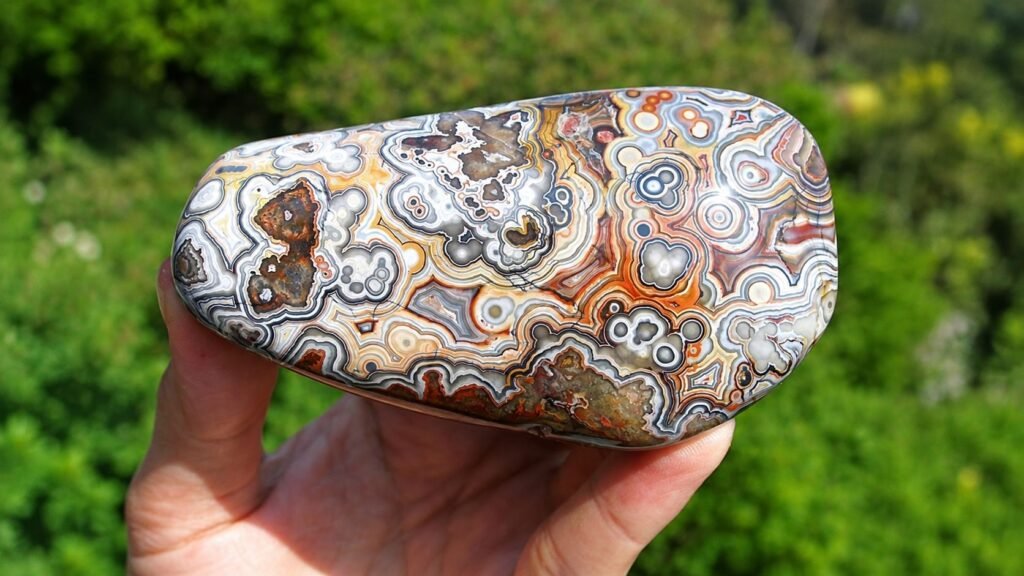
Crazy lace agate is a commercial name for a strongly patterned agate material associated with Mexico. Agate is a form of chalcedony in the quartz family, composed mainly of silicon dioxide. Traditional definitions emphasize banding, while marketplace names often describe a locality, color, pattern, or a combination of those features. Yun Agate’s general guide to what agate is explains how agate relates to chalcedony and quartz.
The “crazy lace” label describes irregular, tightly changing bands, not a laboratory-defined mineral. Thinner areas may appear translucent. Dense bands or staining can look more opaque. Pieces can look very different and still fit the trade description. Color alone is not enough to identify the material.
Feature | What to know |
Material family | Agate/chalcedony in the quartz family; mainly silicon dioxide. |
Trade name | A commercial variety label, not a separate mineral species. |
Characteristic pattern | Irregular curved and twisted bands, including zigzags, scallops, bouquets, sunbursts, and eye-like forms. |
Documented locality | Sierra Santa Lucia, Chihuahua, northern Mexico. This does not verify the origin of every commercial piece. |
Documented colors | Most documented material is gray or white. Red, yellow, orange, or brown bands and staining may also appear. |
Treatment | Natural color and dyeing are separate questions. Treatment status must be established for the individual piece. |
Identification limit | Pattern can support a trade description, but appearance alone cannot prove locality or treatment. |
The name is visual. “Lace” refers to fine, curving bands and repeated edges. “Crazy” describes lines that twist, change direction, and overlap. A 2019 paper by Brad L. Cross in the New Mexico Mineral Symposium describes Sierra Santa Lucia material with curved and twisted bands. The forms include zigzags, scallops, bouquets, sunbursts, and eyes. They help explain the trade name without imposing one formation story on every pattern.
Pattern depends on how silica-rich material filled veins or openings and on how the rough was later cut. A slab across the banding may reveal loops and eyes, while a different orientation can show longer stripes. The cutter’s choices therefore affect what buyers see in a cabochon, bead, or carving.
Crazy lace agate is closely associated with northern Mexico, especially Chihuahua. Cross documents the material in the Sierra Santa Lucia area. It occurs primarily as vein agate in highly siliceous Cretaceous limestone. Mindat also records the trade variety and Mexican locality information. These sources establish regional context, not the origin of every commercial specimen.
Sellers should separate a trade label from verified provenance. “Mexican Crazy Lace Agate” is appropriate when supply-chain records support it. Without locality records, describe the item as sold under the crazy lace agate name. Do not state a specific mine or district as fact.
Retailers use “Mexican crazy lace agate,” “crazy lace agate,” and “Mexican lace agate” with some overlap. The terms are not fully standardized. “Lace agate” is broader and may describe other stones with lace-like banding. Buyers should read the full listing rather than assume every lace agate shares the same material or origin.
Documented Sierra Santa Lucia material is mostly gray and white. Red, yellow, orange, and brown bands or staining may also appear. The geological account attributes much of the color to staining. That does not establish the cause of color in every polished specimen. Natural variation can produce both subdued and vivid pieces.
Look beyond brightness when assessing quality. Does the cut frame the pattern well? Are the lines distinct rather than muddy? Does the polish reveal depth? Beads do not need to be perfectly uniform; controlled variation can add movement. Cracks that threaten durability, chipped drill holes, and poor polish are separate concerns.
Crazy lace agate can be genuine stone material and still have treated color. Agate and chalcedony can be dyed in the gem trade. “Real agate,” “natural color,” and “untreated” are different claims.
GIA explains that dyeing introduces color into porous or fractured gem materials. Durability depends on the dye and treatment used. Under the FTC Jewelry Guides, sellers should disclose treatment when it is not permanent. Disclosure is also needed when it requires special care or significantly affects value. Yun Agate’s detailed dyed agate guide covers this distinction and practical questions buyers can ask.
Concentrated color in surface-reaching cracks, drill holes, pits, or band boundaries may justify questions about dyeing. Unusually uniform neon color can also prompt questions. Neither clue is conclusive, and vivid color does not prove dye. Lighting, white balance, editing, coatings, and natural variation limit what photos can tell you. If treatment matters, ask the seller or seek appropriate laboratory testing.
Identification starts with the material and its pattern. A plausible specimen may show chalcedony-like luster, fine texture, and irregular bands or eyes. Examine several photos of the exact item in neutral light. Ask the seller whether the material is agate or chalcedony. Also ask if the color is natural or treated. Check whether backing, filling, coating, stabilization, or composite construction is present.
Do not use a single scratch test, flame test, solvent test, or internet photo comparison as proof. Destructive home testing can damage jewelry and still give ambiguous results. For a broader explanation of imitations, disclosure, and testing limits, see how to tell if agate is real. An independent gemological report may be appropriate for a high-value purchase, but the report should identify the actual submitted item.
Crazy lace agate differs from blue lace agate, which usually has softer blue-and-white banding. Botswana agate often shows fine, orderly parallel or concentric bands. Laguna agate is another Mexican trade/locality material known for crisp bands and color. These are visual tendencies, not a complete identification key. Trade names can overlap. Cutting can change visible patterns, and appearance alone cannot prove locality.
Some contemporary crystal-market and retail guides call crazy lace agate the “laughter stone.” They associate its lively pattern with joy, optimism, confidence, or emotional balance. These are modern symbolic interpretations, not mineral properties or proof of a universal ancient tradition. People may value the symbolism as a personal story or design theme.
Do not present the stone as a treatment for anxiety, depression, ADHD, circulation problems, pain, or other health conditions. It cannot guarantee luck, protection, emotional change, or spiritual results. Discuss meaning as personal or cultural interpretation, not as a health claim.
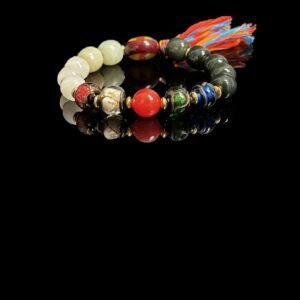
Crazy lace agate can be cut into cabochons, beads, pendants, earrings, display slabs, and small carvings. Pattern placement is part of the appeal. A cabochon may center an eye or sweeping curve. A crazy lace agate bracelet can distribute different bands across the design. Good polishing should reveal the pattern without ripples, dull areas, or heavily abraded edges.
Workmanship affects value and wearability, even when the rough is attractive. Balanced outlines, smooth backs, clean drill holes, secure findings, and thoughtful orientation all matter. For more on cutting and shaping agate, see how agate is carved. That process guidance does not imply that Yun Agate currently sells this specific variety.
Start with the exact item, not just the variety name. A reliable listing should show several clear photos and disclose what is known about the material and treatment. It should not present uncertain locality as fact. If a seller uses one specimen photo for multiple items, ask how much the delivered piece may vary.
There is no responsible universal price range for crazy lace agate. Price depends on pattern, color, cut, size, condition, treatment, documented origin, and craftsmanship. Yun Agate’s agate value guide explains these factors in more detail.
Looking for agate for its patterns and craftsmanship? Browse handmade agate bracelets or hand-carved agate pieces. These are broader collections, not a Crazy Lace Agate collection. Check each listing for its specific material and treatment details.
For routine care, wipe the piece with a soft cloth. If the full design can safely be washed, use lukewarm water, mild soap, and a soft brush. Rinse briefly and dry thoroughly. Avoid hard impacts, sudden temperature changes, abrasive cleaners, and prolonged contact with household chemicals.
Treated color may require extra caution. GIA notes that dye stability varies. Some dyed materials may be affected by solvents or prolonged light exposure. Ultrasonic and steam cleaning are not automatically safe for every assembled piece. Follow the seller’s treatment-specific advice and Yun Agate’s full agate jewelry care guide for full care instructions. Cord, adhesive, metal, wood, or other gemstones may need gentler care.
Crazy lace agate is a trade name for agate or chalcedony with lively, irregular bands, eyes, scallops, and zigzag patterns. It is associated with Mexican material but is not a separate mineral species.
The names can overlap in commerce, especially when sellers refer to Mexican patterned material. “Lace agate” alone is broader, so buyers should check the full description, treatment information, and any locality evidence.
Geological literature documents Crazy Lace Agate in the Sierra Santa Lucia area of Chihuahua. That does not verify the origin of every commercial item.
Some pieces may have natural color, while others may be dyed or otherwise treated. Genuine agate can still have treated color. Ask the seller what is known and do not rely on brightness or photographs alone.
Look for credible material identification, characteristic banding, multiple exact-item photos, treatment disclosure, and a clear return policy. Visual clues can support questions, but laboratory examination may be needed for a conclusive high-value identification.
Agate typically has a Mohs hardness of about 6.5–7, which helps it resist many everyday scratches. Hardness is not the same as toughness, however. The stone can still chip or fracture after a hard impact. Suitability also depends on construction. Check the cut, drill holes, setting, cord or wire, and any treatment, coating, adhesive, or other material.
New Mexico Mineral Symposium — Brad L. Cross, “The Agates and Geodes of Northern Chihuahua and Southern New Mexico” (2019, pp. 22–24) — Documents the Sierra Santa Lucia occurrence, vein form, host rock, band shapes, and color staining.
Mindat — Crazy Lace Agate — Trade-variety and locality record; useful for source context, not product-level provenance.
GIA — An Introduction to Gem Treatments — Dyeing, treatment terminology, stability, and care implications.
GIA — More Than the Mohs Scale: Understanding Gem Durability — Explains why hardness, toughness, and stability are different parts of durability.
Federal Trade Commission — Jewelry Guides — U.S. guidance for truthful gemstone and treatment representation.
Federal Trade Commission — In the Loupe: Advertising Diamonds, Gemstones and Pearls — Plain-language treatment-disclosure principles for marketers.
Symbolia — Crazy Lace Agate Meaning & Properties — Example of contemporary retail symbolism and the “laughter stone” nickname; not scientific evidence.
FEATURED PRODUCTS