Address
Designed & handcrafted in Fuxin, China
Natural agate jewelry made by hand. Worldwide shipping available.
Work Hours
Monday to Friday: 7AM - 7PM
Weekend: 10AM - 5PM
SEP 26,2026
Blue Lace Agate is a recognizable agate variety with a pale blue body and white or lighter blue bands that form soft, lace-like patterns. It belongs to the chalcedony family of fine-grained quartz, but its internal banding distinguishes it from relatively uniform Blue Chalcedony.
Classic material is closely associated with Ysterputs in southern Namibia, although appearance alone cannot prove origin. This guide covers its identity, locality, rarity, treatment, meaning, jewelry uses and buyer checks.
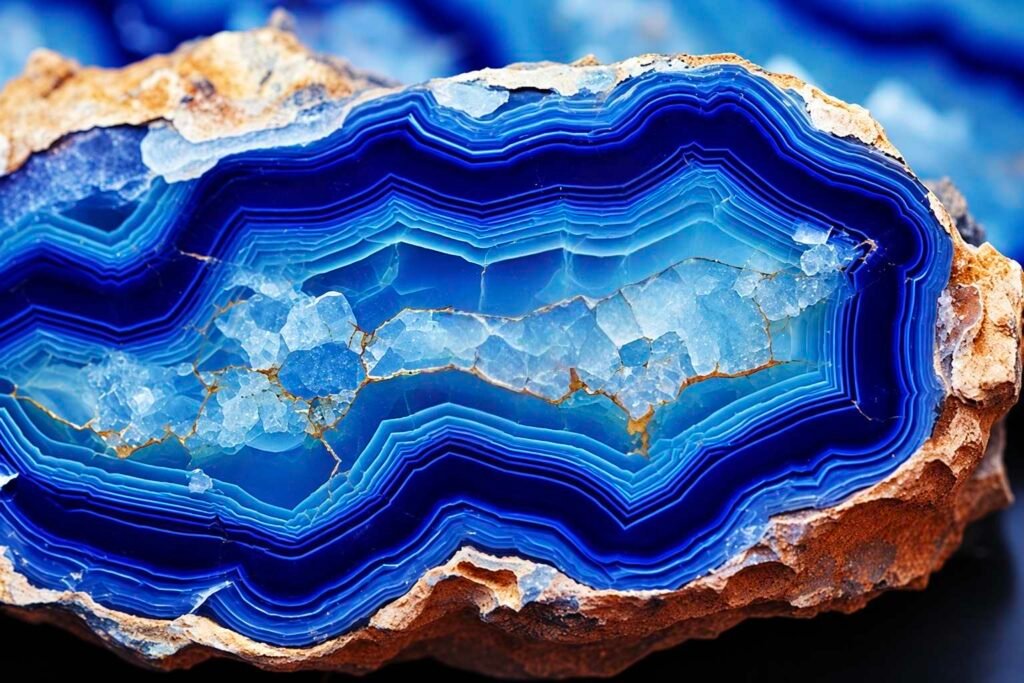
Blue Lace Agate is a banded form of chalcedony. Chalcedony consists of extremely fine intergrown quartz-rich material, while agate generally describes varieties with visible layers or structured patterns.
It usually combines pale, sky or gray-blue areas with white or lighter bands; some pieces lean lavender-blue. It may be translucent, cloudy or partly opaque, with either delicate or broader patterns. These characteristics place it within the wider range of agate types, colors and formation, but not every light blue chalcedony specimen qualifies as Blue Lace Agate.
The “lace” consists of internal bands that curve, ripple or form concentric layers. Their pale blue and white contrast creates the fabric-like appearance suggested by the name.
Band thickness, translucency, cutting direction and layer arrangement affect the finished pattern. Ysterputs material has detailed published mineralogy, but those locality-specific findings should not be assumed for every commercial specimen.
These materials belong to the same broader family, but their names describe different levels of specificity.
Blue Agate is a broad market category that may include naturally blue-gray agate, dyed material and several patterns.
Blue Lace Agate has a narrower identity: pale blue material with white or lighter wavy bands. Uniform blue agate without that pattern should not automatically receive the Blue Lace name.
Chalcedony is the broader fine-grained quartz material. Agate is typically its banded or patterned subset, and Blue Lace Agate is a lace-banded blue agate variety.
Uniform translucent blue material may be more appropriately called Blue Chalcedony. Trade terms are not always consistent, so the internal pattern and material description matter more than the color name alone.
Ysterputs in southern Namibia was the principal documented source of classic Blue Lace Agate for decades, and published research confirms mining there until 2017. The locality became closely associated with pale blue-and-white material supplied to lapidaries and jewelry makers.
At Ysterputs Farm 254, the material occurred in a hydrothermal vein deposit within fractured rock. Commercial production developed during the second half of the twentieth century and supplied beads, cabochons, carvings and ornamental objects.
Its documented history made Ysterputs central to the stone’s modern identity, but it does not mean every item labeled Blue Lace Agate can be traced there.
No. Similar lace-banded blue chalcedony and agate material has been reported from other localities. Pale color and lace pattern cannot establish geographic provenance.
If a seller describes a piece as Namibian or Ysterputs material, that claim should ideally have reliable sourcing support. Photography can show appearance but cannot prove where the rough was mined.
Blue Lace Agate can be limited in supply in certain qualities and documented origins, but it is not accurate to describe every piece as rare. Ysterputs production ceased in 2017, constraining documented material from that source. Old stock, existing inventory and finished jewelry remain available, and similar material occurs elsewhere.
Fine, strongly patterned, large or documented Ysterputs pieces may command more. Treatment, cutting, condition and craftsmanship also affect price. “Rare” should not describe every Blue Lace Agate item without qualification, and the end of production does not by itself prove that a deposit is geologically exhausted.
Natural Blue Lace Agate exists, but treatment varies by piece. Chalcedony can accept dye, and other patterned material may receive an overly broad Blue Lace label.
Ask separately whether the material is genuine chalcedony, whether its color is natural, whether it was treated, whether it is an imitation and what the seller has disclosed.
A genuine agate can be dyed. Dyeing changes the color origin but does not turn chalcedony into glass or plastic. Treated genuine material is not automatically fake, although known treatment should be disclosed.
Glass, resin or another substitute is different. Material identity, natural color and treatment should not be collapsed into one “real or fake” label.
Not conclusively. Color concentrated around drill holes, fractures or porous layers, or unusually uniform saturation, may justify closer inspection.
These are clues, not proof. Pale blue does not guarantee untreated color, and intense blue does not prove dye. Photos cannot confirm origin either. Combine non-destructive observation with seller disclosure, and consult how to tell if agate is real instead of trying scratch, heat, acid or solvent tests.
Start with actual-item photographs. Look for internal pale blue and white wavy banding, then examine several angles for translucency, polish, chips, cracks and drill-hole condition.
The listing should identify the material, disclose known treatment and separate confirmed origin from assumption. For beads, assess variation across the strand, drilling, finish and construction. Check return terms before buying.
“AAA,” “rare,” “mine stock” and “Namibian” are not proof by themselves. A trustworthy seller explains what supports those descriptions and acknowledges what remains unknown. No single visual feature proves authenticity, untreated color or provenance.
Blue Lace Agate has no single universal meaning. Its pale color and flowing pattern may personally suggest calm, reflection, gentle communication, clarity, water, sky or quietness. A wearer may also connect it with a gift, memory or personal story.
Calm, communication and throat-chakra associations are modern crystal beliefs, spiritual interpretations or personal symbolism—not demonstrated medical or psychological effects. Blue Lace Agate is not scientifically established to treat anxiety, reduce stress, provide protection or create emotional outcomes.
Blue Lace Agate is cut into beads, cabochons, pendants, earrings, bracelets, necklaces and small carvings. Cabochons display the flowing bands broadly, while beads create a changing sequence around a strand.
Its blue-white palette works with silver-colored metals, warm gold tones and neutral materials. Because each cut reveals a different portion of the banding, matching several natural pieces may require careful selection.
Use lukewarm water, mild soap and a soft cloth or brush, then dry the piece thoroughly. Avoid harsh chemicals, excessive heat and hard impacts, and store it separately where practical.
Use extra caution with known dyed or treated material, as harsh chemicals or excessive heat may affect its appearance.See the complete agate jewelry care guide for mixed-material pieces.
It is a pale blue agate variety defined by white or lighter lace-like internal banding.
Natural material exists, but treated chalcedony also appears in commerce. Treatment should be evaluated and disclosed for the individual piece.
Ysterputs in Namibia was its principal documented source for decades. Similar material is reported from other localities.
No. Color and banding cannot prove origin, so a Namibian claim needs sourcing support rather than visual assumption.
Strongly patterned, large or documented Ysterputs material can be limited, but not every commercial Blue Lace item is rare.
Blue Agate is a broad category. Blue Lace Agate is the specific pale variety with light lace-like bands.
Blue Chalcedony may be relatively uniform. Blue Lace Agate has characteristic pale lace-like bands.
It may personally symbolize calm, reflection or gentle communication. These meanings are interpretations, not scientifically demonstrated effects.
FEATURED PRODUCTS