Address
Designed & handcrafted in Fuxin, China
Natural agate jewelry made by hand. Worldwide shipping available.
Work Hours
Monday to Friday: 7AM - 7PM
Weekend: 10AM - 5PM
OCT 7,2026
How much is agate worth? There is no single price that applies to every piece. Agate can be sold as inexpensive rough material, a polished slab, a loose bead, finished jewelry, or a detailed carving. Each form combines different amounts of usable stone, labor, design, and retail service. Value also changes with pattern, color, translucency, condition, treatment disclosure, cutting quality, craftsmanship, and buyer demand. The most useful way to judge an agate stone price is therefore to identify exactly what is being valued and compare it with genuinely similar items, rather than relying on one universal price per carat or gram.
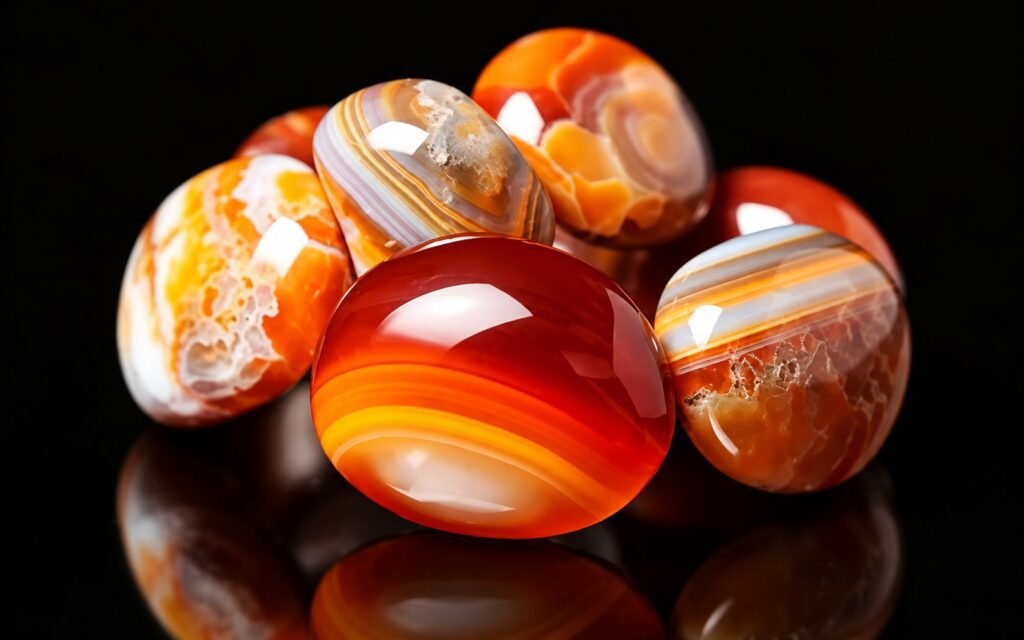
An agate is worth what informed buyers are willing to pay for that particular material or finished object in its current market. A rough nodule, a polished specimen, a calibrated cabochon, a matched bead strand, a necklace, and a carved sculpture are not directly comparable. Their prices reflect different combinations of material quality, usable size, preparation, labor, condition, and presentation.
That is why the question how much is agate worth per gram often has no reliable answer without more context. Weight may be one part of a rough-material sale, but a finished piece may be priced mainly by cutting, matching, setting, carving, or design. One price-per-carat figure can hide the qualities that actually matter to the buyer.
Agate is a broad family of patterned chalcedony rather than a standardized commodity. If you need the mineral background first, Yun Agate’s guide to what agate is explains its relationship to chalcedony and quartz. Within that material family, natural variation is substantial. Two pieces from the same general type can differ in pattern, contrast, translucency, fractures, usable area, and overall appeal.
Commercial form adds another layer. Rough may be sold by weight, slabs by size or visual character, beads by strand or piece, jewelry as a finished design, and carvings as individual objects. Treatment, documentation, workmanship, seller overhead, return terms, and the audience being served can all affect the asking price. There is no official agate exchange or universally accepted retail schedule that converts those differences into one fixed number.
Named varieties can attract different levels of collector or buyer interest, but a name alone does not establish value. Quality can vary widely within the same variety. Documented provenance may matter for collector material when the location is known, relevant, and supported by reliable records. A geographic trade name or seller description should not be treated automatically as proof of mining origin. Claims that a piece is rare, local, historic, or from a celebrated deposit should be evaluated on evidence rather than appearance alone.
Buyers often respond to crisp banding, landscape-like inclusions, strong contrast, balanced color zones, or a composition that works well in the finished shape. Translucency can add depth, but opacity is not automatically a defect; some designs depend on dense color or sharply visible patterns. Evenness may be desirable in a matched strand, while intentional variation may make a specimen or carving more distinctive. No single color is universally the most valuable. The relationship among pattern, color, form, and buyer preference matters more.
Treatment status can influence value because it changes what the buyer understands about the stone. Dyed agate is still genuine stone material when the underlying material is agate or chalcedony, but the color has been altered. It is not automatically worthless, and naturally colored agate is not automatically more valuable. Quality, disclosure, stability, appearance, and market expectations all matter. Bright color alone is not proof of dyeing.
For U.S. sales, the FTC’s Jewelry Guides advise disclosure when a gemstone treatment is not permanent, requires special care, or significantly affects value. Buyers who need identification clues can use Yun Agate’s guide on how to tell if agate is real. The value question is narrower: was the treatment represented clearly enough for the buyer to compare the item fairly?
Larger pieces can cost more when they preserve desirable pattern, sound material, and useful proportions, but size does not overcome poor condition or weak visual quality. In rough agate, hidden fractures can reduce cutting yield. In a slab or cabochon, chips and cracks may interrupt the design or threaten durability. In beads, damaged drill holes can weaken the strand. Usable material, structural soundness, and the intended purpose matter more than weight by itself.
Material value and finished-piece value are different. Cutting can reveal a stronger pattern, protect a fragile edge, or waste otherwise usable stone. An even polish, accurate shape, clean drilling, secure setting, and thoughtful matching require time and skill. Carving adds design decisions, controlled material removal, surface finishing, and the risk of loss during production. A modest raw stone can therefore become a more expensive finished object because the price also reflects labor, design, finish quality, and construction. Handmade work should still be judged by execution; the label alone does not guarantee higher value.
Rough buyers look at overall size, visible pattern, fractures, cutting potential, and specimen appeal. A nodule with little visible interior may involve more uncertainty than a slab that already reveals its bands or inclusions. Some rough is useful for lapidary work; other pieces are valued mainly as natural specimens. Compare rough with rough of similar type, condition, and preparation. A per-pound or per-gram listing can be useful for a specific batch, but it should not be treated as a general value for all agate.
Cabochon value depends on how well the cut presents the pattern, whether the dome and outline are controlled, and whether the polish is even. Loose beads add drilling quality, size consistency, shape, and surface finish. A matched strand may require sorting many beads for compatible color, diameter, translucency, and pattern, so its value structure differs from an equal weight of rough. Check for chips around drill holes, uneven polish, obvious repairs, and whether photographs show the actual stones being sold.
The retail price of agate jewelry is not the raw gemstone value. It may include the agate, other stones, metal or nonmetal components, cord, findings, design work, assembly, finishing, sizing, packaging, quality control, customer service, and normal retail costs. Precious-metal content can also change the comparison substantially. When evaluating jewelry, compare pieces with similar materials, construction, dimensions, treatment disclosure, and workmanship rather than comparing only the weight of the agate.
For a carving, value can reflect design, the way natural bands or color zones are used, dimensional complexity, surface finish, condition, documentation, and the quality of the completed form. More carving is not automatically better; weak design, unresolved surfaces, or structural damage can limit appeal. Regional craft context may help explain workmanship, as in Yun Agate’s overview of Fuxin agate carving, but the material’s mining origin should remain separate from where the object was carved. Buyers can also compare the finish and composition of actual hand-carved agate sculptures rather than relying on a generic price label. For a closer look at the process, see how agate is carved from rough stone to a finished object.
Is agate expensive? As a broad material family, agate is not automatically expensive, and many everyday pieces are accessible. Individual items can command much higher prices when desirable material, documented provenance, exceptional pattern, large usable size, careful matching, skilled craftsmanship, strong condition, and current demand come together. A high asking price does not prove high value, and an affordable piece is not necessarily poor quality. The meaningful question is whether the price is reasonable for that form, quality, documentation, and selling context.
A buyer does not need to assign a formal appraisal value to make a better comparison. Use the following sequence to keep material, workmanship, and seller claims separate.
Marketplace listings can help establish what sellers are currently asking for similar objects, but an asking price is not the same as an actual sale price. Neither is automatically the item’s replacement value for insurance or its value in a professional appraisal. Keep those concepts separate when making comparisons.
Most ordinary agate purchases do not require a professional appraisal. Independent advice may be useful for higher-value jewelry, insurance documentation, estate or tax matters, an unusual collector object, supported provenance, or a piece whose material and value cannot be evaluated confidently from ordinary sales information. Before hiring an appraiser, clarify the purpose of the valuation and ask about relevant gemstone or jewelry experience. An appraisal is an opinion for a defined purpose and date, not a guarantee of what an item will sell for.
It depends on the form, quality, condition, treatment, workmanship, documentation, and market. Rough agate, beads, jewelry, and carvings should be compared within their own categories rather than assigned one universal price.
Agate as a broad material is not automatically expensive. Some pieces are modestly priced, while exceptional specimens or highly finished objects can cost much more because of quality, craftsmanship, documentation, or demand.
There is no reliable universal ranking. Even within a named variety, value changes with pattern, condition, treatment, usable size, documentation, form, workmanship, and current buyer interest. Evaluate the individual item rather than the name alone.
Sometimes treatment affects price, but dyed agate is not automatically worthless and natural color is not automatically more valuable. Clear disclosure, color stability, quality, workmanship, and buyer expectations all influence the comparison.
It may be sold by weight, dimensions, strand, or individual piece depending on its form and market. Finished jewelry and carvings are usually poor candidates for simple price-per-carat comparisons because labor and other components contribute substantially to price.
Look for an appealing and well-presented pattern, sound condition, good cutting or finish, clear treatment information, and credible documentation for special claims. Then compare it with genuinely similar items and recent market evidence.
Good craftsmanship can add value through design, skilled labor, controlled use of the stone, and a strong finish. Carving does not guarantee value; execution, condition, material use, and buyer demand still determine whether the finished object commands a premium.
International Gem Society — Agate Value, Price, and Jewelry Information — Agate properties, varieties, enhancements, and general value factors.
International Gem Society — Determining Gemstone Value, Price, and Appraisals — The distinctions among market price, value, and appraisal context.
GIA — An Introduction to Gem Treatments — Treatment types, disclosure, durability, and care considerations.
Federal Trade Commission — Jewelry Guides — U.S. guidance for truthful descriptions and gemstone treatment disclosures.
Federal Trade Commission — In the Loupe — Practical guidance on advertising gemstones and disclosing treatments.
Geology.com — Agate Gemstones — General agate background, forms, and jewelry uses.
FEATURED PRODUCTS