Address
Designed & handcrafted in Fuxin, China
Natural agate jewelry made by hand. Worldwide shipping available.
Work Hours
Monday to Friday: 7AM - 7PM
Weekend: 10AM - 5PM
OCT 5,2026
Fuxin is a municipality in Liaoning Province in northeastern China. It is associated with agate through local resources, a documented carving tradition, and a modern network of processing and trade. Those connections should not be treated as interchangeable. An agate object carved in Fuxin may have been made from stone mined elsewhere, so accurate descriptions separate the material’s source from where the object was carved, finished, or sold.

Fuxin lies in northwestern Liaoning Province. Liaoning is part of northeastern China, a region often called Northeast China. Fuxin is a municipality rather than a province or a single mining village, and its agate activity extends across a wider urban and county-level industry. For buyers, the location matters because the name Fuxin may refer to a material source, a place of manufacture, or the commercial network through which a stone passed.
That administrative distinction also helps when reading addresses and certificates. A workshop, market, mine, or seller may all be connected to the Fuxin municipality without being at the same site. A precise claim gives the relevant city, county, or region and explains what happened there instead of relying on Fuxin as a catch-all origin label.
China’s official intangible cultural heritage record describes Fuxin as one of the country’s four major agate-producing areas. This supports a real local resource history, but it does not establish that every agate handled in the city was mined there. Readers who want the broader geological picture can also review where agate forms and is found.
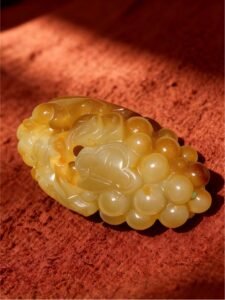
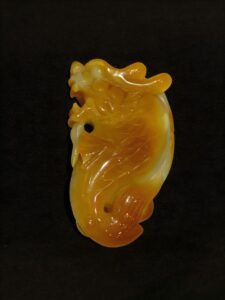
Fuxin also developed as a center for Chinese agate carving and related processing. Workshops may select rough, remove surface material, plan a design, shape an object, refine details, polish it, or fit it to a base. Jewelry production can involve a different combination of cutting, drilling, grinding, polishing, stringing, weaving, and assembly. The exact claim should match the work performed on the specific object.
Modern Fuxin is part of a wider rough-stone and finished-goods network. Local government planning has discussed importing rough agate from Uruguay and Brazil for processing by local businesses. That evidence is useful because it confirms that Fuxin’s industry is not limited to local deposits. A piece can be legitimately carved or finished in Fuxin while its raw material comes from another country or another part of China.
Trading areas such as Shijiazi connect suppliers, processors, makers, and buyers. Material may be sold as rough, preforms, beads, components, or finished objects, and it can change hands several times. The city where a seller bought a stone therefore is not necessarily the place where the stone formed, was mined, or received its final workmanship.
The phrase Fuxin agate does not identify one mineral variety. It can describe several different relationships between a stone, an object, and the city. Good product copy states which relationship applies instead of leaving the customer to infer it.
Possible meaning | What it can accurately describe | What it does not prove |
Mined in the Fuxin region | Rough stone whose extraction location is documented in the Fuxin area | That every stone sold or carved in Fuxin has the same source |
Carved or finished in Fuxin | An object shaped, carved, polished, or finished there | That the rough stone was mined locally |
Traded or processed through Fuxin | Material bought, sorted, cut, or distributed through the local industry | A geological origin in Fuxin |
Fuxin city, cultural, or industry identity | The city’s recognized relationship with agate craft and commerce | A mineral variety, quality grade, or origin certification |
The same caution applies to the phrase Chinese agate. It can indicate geography, workmanship, cultural context, or trade, but it does not define one color, pattern, treatment status, or geological source. Product-specific records are more useful than a broad label.
A useful provenance record can contain more than one true place name. For example, rough might be mined in one country, selected and carved in Fuxin, set into metal elsewhere, and sold by a Fuxin-based brand. Listing those steps separately gives the customer more information and does not diminish the value of Fuxin workmanship.
The Chahai archaeological site in the Fuxin region is roughly 7,600 to 8,000 years old. It is important evidence of early human settlement and material culture in the area. Its age should not be converted into a claim that Fuxin has 8,000 continuous years of agate mining or carving. The site and the later carving tradition are related to the same region, but they do not prove an uninterrupted craft lineage.
The official heritage record points to agate objects excavated from Liao-period tombs in Qinghemen. These objects provide firmer evidence for an agate-working tradition in the Fuxin area about 1,000 years ago. They support a long regional history without requiring an exaggerated claim of continuous practice from prehistoric times to the present.
Archaeological evidence, later historical objects, official heritage recognition, and present-day workshop activity are different kinds of evidence. Read together, they show that agate has mattered in the region across distinct periods. They should still be dated and described separately so that gaps in the record are not presented as proven continuity.
Fuxin agate carving entered China’s first national list of representative intangible cultural heritage projects in 2006. The entry is Project No. 329, VII-30, in the Traditional Fine Arts category, and it names the Fuxin Agate Association as the protection unit. The listing recognizes the defined heritage project; it does not certify every business, artisan, or agate product made in Fuxin.
A 2025 Fuxin Municipal Government response explains the project’s specific scope through the term suhuo (素活): archaistic agate vessels modeled on forms associated with Shang and Zhou bronzes and with Qin and Han vessels or incense burners. Suhuo should not be used as a general label for all agate carving, bracelets, beads, or contemporary jewelry.
In 2016, the World Crafts Council designated Fuxin as a WCC-World Craft City for Agate. This is the verified international title. The phrase World Agate Capital appears in local city branding and English translations, but it should not be presented as a geological certification, a guarantee of material origin, or an uncontested ranking of global reserves.
An agate carving workflow depends on the rough stone and the intended object. The official heritage entry lists stages including material selection, skin removal, design, polishing, rough carving, fine carving, and fitting a base. That sequence describes traditional carved objects and should not be imposed on every workshop or jewelry product.
Agate often contains bands, color zones, inclusions, cavities, or an irregular outer form. A carver may plan around those features rather than force the material into a standard shape. Qiaose (俏色) describes design that makes deliberate use of natural color zones. Suixing (随形) describes work that follows the stone’s natural form. Both terms should be used only when the finished object and its documented process support them.
After inspection and design, a maker may remove unwanted outer material and establish the main silhouette. Finer tools can then define contours, relief, openings, textures, or small details. Polishing changes the surface and makes color, translucency, and tool work easier to read. The order and tools vary with the object, and a finished description should name only the techniques that can be verified.
Because carving is subtractive, early choices affect what remains possible later. Fractures, thin color layers, cavities, and changes in translucency may require a revised design. This is one reason finished objects can differ even when the maker begins with similar rough: the design must respond to the usable material in each piece.
Carving removes material to create a deliberate form or image. Bead and jewelry making may include sawing, grinding, drilling, polishing, matching, stringing, weaving, setting, or assembly without figurative or relief carving. Both require skill, but they are not the same process. A polished bead bracelet should not be called hand-carved unless carving actually occurred.
A place-of-manufacture claim answers a different question from a material-origin claim. If a piece was carved in Fuxin from imported rough, the accurate wording is “Material: agate” and “Carved in Fuxin, China,” with the material source added only when it is documented. A jewelry piece might instead say “Finished in Fuxin, China” or “Assembled in Fuxin, China.”
The field “Place of Origin: Fuxin” is ambiguous when it only refers to workmanship. It can cause a buyer to assume that the stone was mined locally. Clear listings separate material, known material source, treatment, and each relevant making location. Names such as Nanhong, moss agate, or Warring States red agate also need their own accurate origin and material descriptions; processing in Fuxin does not give them a Fuxin geological origin.
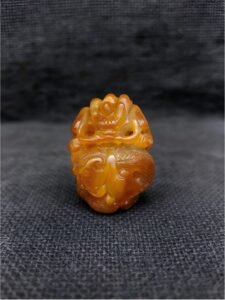
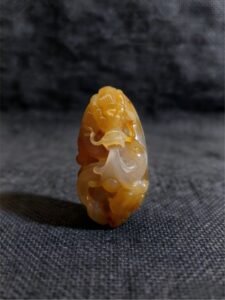
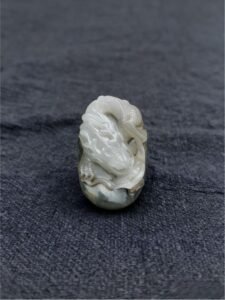
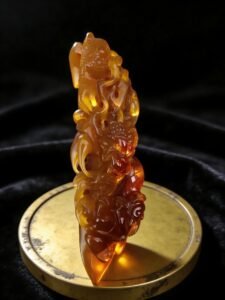
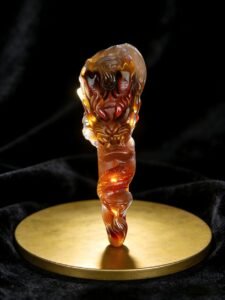
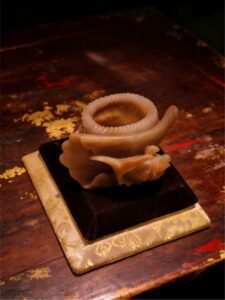
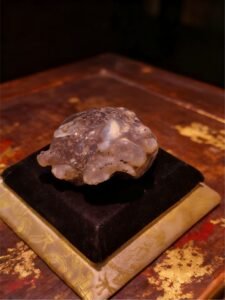
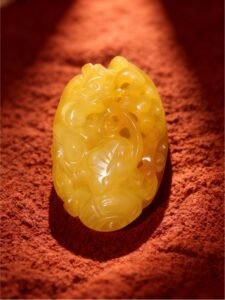
Yun Agate is connected to Fuxin and works within the city’s contemporary agate-making environment. That connection can include jewelry, carved collectibles, and handcrafted finishing, while material origin remains product-specific. Readers can learn more about Yun Agate’s Fuxin background and browse hand-carved agate collectibles or handheld agate art. Each product description should state what Yun can document about material, treatment, workmanship, and source.
Read a listing as a set of separate claims. Start with the material name, then check whether the source of the rough is known. Look for treatment disclosure and an exact statement of where carving, finishing, or assembly occurred. If artisan identity or a named technique affects value, ask who performed the work and what documentation supports the claim.
For a broader material check, use Yun Agate’s guide on how to evaluate agate identity and seller disclosure. The Nanhong agate origin guide also shows why a locality name should be tied to a specific, supportable claim rather than used as a general signal of quality.
A clear listing might read: “Material: agate. Material source: Uruguay. Carved and polished in Fuxin, China. Treatment: none known,” if records support every statement. When the material source is unknown, it is more accurate to say so than to substitute the workshop location. Buyers can then judge the object on the facts available rather than on an implied origin.
What is Fuxin agate?
Fuxin agate is a broad commercial and cultural phrase. It may refer to locally mined material, an object carved or finished in Fuxin, material traded through the city, or Fuxin’s agate industry. The seller should state which meaning applies.
Where is Fuxin, China?
Fuxin is a municipality in northwestern Liaoning Province in northeastern China.
Is all Fuxin agate mined in Fuxin?
No. Fuxin processes locally sourced and nonlocal rough. An object made in Fuxin may be carved from stone mined elsewhere.
Why is Fuxin known for agate carving?
Fuxin combines a documented regional carving history with local resources and a modern processing and trade network. Official records include Liao-era objects, a 2006 national heritage listing, and a 2016 World Crafts Council designation.
Is Fuxin agate carving recognized as intangible cultural heritage?
Yes. The defined Fuxin agate carving project was included in China’s first national representative list in 2006 as Project No. 329, VII-30, in Traditional Fine Arts. This does not certify every product or workshop in the city.
What does ‘World Agate Capital’ mean?
It is a local city-brand expression. The verified international title is WCC-World Craft City for Agate, awarded to Fuxin in 2016. Neither phrase certifies where an individual stone was mined.
How can buyers distinguish where agate was mined from where it was carved or finished?
Look for separate fields for material, material source, treatment, carving location, finishing location, and assembly location. Ask for item-specific documentation when origin or artisan claims affect the price.

FEATURED PRODUCTS