Red Agate vs Carnelian: The Short Answer
The clearest difference is usually how the material is described and patterned, not a hard mineral boundary. Carnelian emphasizes an orange-to-red color range, while Red Agate usually emphasizes visible agate structure in red-colored chalcedony.
Feature | Carnelian | Red Agate |
Material family | Chalcedony | Chalcedony, typically described as agatic or patterned |
Typical color | Orange, red-orange and reddish-brown | Red, deep red, brown-red or red-orange |
Banding | Often relatively uniform, but bands may occur | More often sold for visible bands or patterns |
Translucency | Commonly translucent to semi-opaque | May be translucent, cloudy or more opaque |
Trade terminology | May also appear as Carnelian Agate | A descriptive market term with flexible usage |
Treatment | Heat or other enhancement may be encountered | Dyeing or other color treatment may be encountered |
No single feature in this table proves a stone’s identity, natural color or treatment status. Sellers may use the same name for materials that look different, or different names for closely related material.
What Is Carnelian?
Carnelian is an orange to reddish-brown variety of chalcedony. It is often translucent to semi-opaque and may look evenly colored, softly clouded or slightly mottled. Color depth can vary within one bead or between beads in the same bracelet because natural chalcedony is not perfectly uniform.
Some banded orange-red material is still sold as Carnelian, Carnelian Agate or banded Carnelian. That trade usage is one reason a rule such as “Carnelian never has bands” is too rigid. The label usually communicates color and overall appearance rather than a laboratory-grade boundary.
What Is Red Agate?
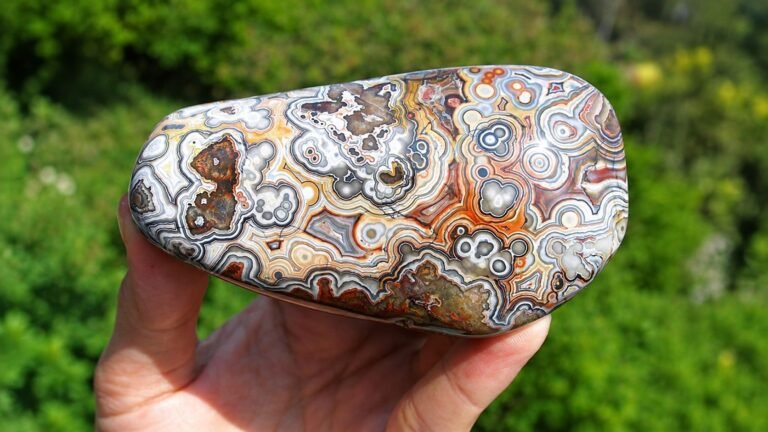
Red Agate is commonly used as a descriptive trade term for red-colored agatic or patterned chalcedony. A piece may show straight, curved or concentric bands, cloudy layers, darker zones or subtle internal structure. Other material sold under the same name may look comparatively uniform.
Red Agate is not one rigid geological species with a required shade or pattern. Buyers should examine the material description and actual piece.
Is Carnelian a Type of Agate?
Carnelian and agate are both forms of chalcedony, but the words normally emphasize different features. Carnelian emphasizes orange-to-red color. Agate usually emphasizes visible bands, layers or patterned structure.
Relatively uniform reddish chalcedony may be called Carnelian, while visibly banded red chalcedony may be called Red Agate. Commercial naming is less consistent, and “Carnelian Agate” is used for material that combines Carnelian-like color with agate-style patterning.
How Do Red Agate and Carnelian Look Different?
Color
Carnelian most often ranges from orange and red-orange to reddish-brown. Red Agate may appear brighter red, deeper brown-red or patterned with lighter and darker red zones. Their color ranges overlap substantially, so color alone cannot settle the name.
Banding and Pattern
Visible banding is the most useful descriptive clue. Red Agate more often refers to material with bands, layers or distinct internal patterns. Carnelian is often more even or softly clouded. However, banded Carnelian exists in trade, and some products labeled Red Agate show only faint patterning.
Translucency
Carnelian commonly allows some light through, especially at thin edges, but it can also be semi-opaque. Red Agate may be translucent, cloudy or comparatively opaque depending on its structure and inclusions. Lighting, bead thickness and photography can change the apparent translucency, so it is not a conclusive test.
Natural Color, Heating and Dyeing
Material identity, color origin and treatment are separate questions. Genuine chalcedony can have altered or enhanced color. The GIA treatment guide explains dyeing as introducing colored dyes into porous or fractured gems; agate can accept dye, while commercial Carnelian may be heated in some cases. Treatment does not automatically make genuine material an imitation.
The buyer issue is accurate disclosure. A seller should distinguish a natural-color stone from genuine agate or chalcedony that has been heated, dyed or otherwise treated. Vivid color may justify asking about treatment, but it does not prove dyeing by itself. Pale or uneven color does not prove that a stone is untreated.
Can You Tell Them Apart From a Photo?
A photograph can show color, banding and translucency, but it cannot conclusively identify the material or treatment status. Stock images may also hide variation between the pictured and delivered item.
Color concentrated in fractures, porous layers or around drilled holes can be worth examining, but these are inspection clues rather than universal proof. Avoid scratching, heating or exposing jewelry to chemicals. Yun Agate’s guide to how to tell if agate is real explains safer ways to evaluate seller information, construction and material claims.
Where Does Nanhong Agate Fit?
Nanhong is a specific Chinese material and trade category within the broader red agate and chalcedony landscape. Not every Red Agate is Nanhong, and Nanhong should not automatically be relabeled as generic Carnelian. Yun Agate’s guide to what Nanhong Agate is covers its identity and buying considerations in greater detail.
A photograph cannot establish a claimed Chinese locality or specific source. If origin materially affects a seller’s price or description, ask what documentation supports the claim.
What Should Buyers Check?
Start with the seller’s exact terminology. Does the listing identify Carnelian, Red Agate, Carnelian Agate or another variety? Check whether the seller discloses natural color, heating, dyeing or uncertainty about treatment. Clear language is more useful than a guarantee based only on appearance.
Use actual-item photographs when possible. Compare color distribution, bands, clouding, drill holes, fractures, polish and bead consistency. Natural variation does not prove untreated color. For bracelets, confirm bead size, wrist measurement, construction, resizing and return terms.
Care information matters as well, especially when a stone is known to be dyed or treated. Follow appropriate agate jewelry care and avoid harsh chemicals or extreme heat. Readers who want to compare finished designs can browse Yun Agate’s handmade agate bracelets after deciding which material description and appearance suit them.
Frequently Asked Questions
Are Red Agate and Carnelian the same?
They are closely related chalcedony materials, but the names usually emphasize different appearances. Carnelian emphasizes orange-to-reddish-brown color, while Red Agate more often emphasizes red material with agate-style bands or patterns. Trade usage can overlap.
Is Carnelian an agate?
Carnelian and agate belong to the chalcedony family. Agate normally refers to banded or patterned chalcedony, while Carnelian is named mainly for its orange-to-red color. Banded material may be sold as Carnelian Agate.
Can Carnelian have bands?
Yes. Carnelian is often relatively uniform or softly clouded, but banded orange-red chalcedony may still be described as Carnelian or Carnelian Agate.
Can Red Agate be dyed?
Yes. Genuine agate can accept dye, although not every Red Agate is dyed. Sellers should disclose treatment when it is known or relevant.
Is dyed Red Agate fake?
Not automatically. A dyed piece may still be genuine agate. The material identity, natural color origin and treatment status should be described separately.
Can you distinguish Red Agate from Carnelian in a photo?
Not conclusively. Photos show pattern, color and translucency, but they cannot reliably prove treatment, origin or exact trade identity.
Is Nanhong Agate the same as Carnelian?
Not exactly. Nanhong is a specific Chinese material and trade category within the broader red agate and chalcedony landscape. It should not automatically be treated as a generic synonym for Carnelian.