Fire Agate vs Red Agate: The Quick Difference
Feature | Fire Agate | Red Agate |
Defining feature | Iridescent, moving “fire” | Red body color |
Typical body color | Commonly brown beneath the display | Red, orange-red or red-brown |
Optical effect | Colored flashes under reflected light | Usually no comparable iridescence |
Pattern or structure | Often botryoidal, with curved layers | May be banded, cloudy or relatively even in color |
Common sources | Central Mexico and the U.S. Southwest | Many sources under broad trade naming |
Treatments | Disclosure matters; the fire is structural | Red may be natural or enhanced |
Jewelry appearance | Changes with angle, light and cut | Read mainly through color and pattern |
What Is Fire Agate?
Fire Agate is a trade and gemological name for iridescent chalcedony, a fine-grained form of quartz. Its rough commonly develops in rounded, botryoidal forms. Cutters work with curved layers to reveal the display without removing the thin fire-bearing zone. For material-family context, see agate types, colors and formation.
Is Fire Agate Really an Agate?
The answer depends on how strictly “agate” is defined. Fire Agate is an established name for this iridescent chalcedony. Under definitions that reserve agate for distinctly banded chalcedony, whether every specimen qualifies as “true agate” is more complicated. It is neither unrelated to agate nor identical to ordinary banded agate.
What Creates the Fire Effect?
The leading explanation is thin-film interference involving thin, iron-bearing layers within the chalcedony. Reflected light interacts across them, producing shifting spectral colors. The GIA review of phenomenal gemstones describes the botryoidal structure and iridescence while noting that detailed scientific study remains limited. This is a leading optical explanation, not a mechanism settled in every detail.
What Is Red Agate?
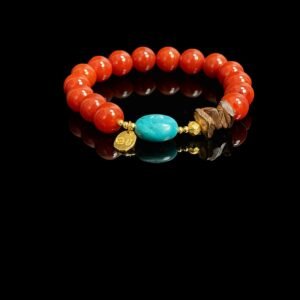
Red Agate is a broad market description for red, orange-red or red-brown agatic and chalcedony material. It is defined mainly by body color, which may be natural or enhanced. Trade boundaries can overlap with carnelian or narrower names such as Nanhong, so Red Agate vs Carnelian and what Nanhong Agate is are separate identification questions.
Fire Agate vs Red Agate: Key Differences
Optical Fire vs Body Color
Fire Agate is identified by angle-dependent iridescence. Its flash can include green, yellow, orange and red even over a brown body. Red Agate is described primarily by its red body color rather than an angle-dependent optical effect. A flame-colored agate is not Fire Agate without the characteristic optical effect.
Botryoidal Form vs Banded or Color-Based Appearance
Fire Agate commonly forms rounded botryoidal surfaces and curved layers. Red Agate may be banded, cloudy, translucent or relatively uniform. Fire Agate is often cut and shaped carefully around its fire-bearing layers, while Red Agate is generally cut to emphasize color and pattern.
Geographic and Trade-Name Differences
Classic Fire Agate sources include central Mexico and the southwestern United States, particularly Arizona. Red Agate is a broader global category. “Mexican Fire Agate” should describe Mexican provenance, not any specimen with orange-red flashes. Appearance cannot confirm origin.
Cutting and Jewelry Appearance
Fire Agate is often polished into freeform cabochons that follow natural contours. A flat or deep cut can weaken or remove the display. Red Agate is commonly made into beads, cabochons and carvings. Fire Agate is angle-dependent; Red Agate usually reads first as color.
How Can You Identify Fire Agate?
Look for iridescence that shifts across curved areas as the stone moves under reflected light. Rotate it slowly rather than judging it face-on. Fire may cover only part of the surface and change with angle. Online, request a moving-light video of the actual piece; stock photos cannot show individual coverage.
Polishing should expose the display while preserving its thin layers. Natural contours are not automatically defects, but check whether pits, chips or fractures affect durability. See how to tell if agate is real for broader checks without destructive tests.
Can Dyed Red Agate Be Called Fire Agate?
No—not based on color alone. Dye can change genuine chalcedony’s body color, but it does not create Fire Agate’s layered optical structure. A dyed stone may still be genuine agate; material identity and natural color are separate questions. GIA’s gemstone treatment guidance explains why disclosure matters. Treatment does not automatically make a stone an imitation.
Can a Photograph Prove It Is Fire Agate?
A photograph can suggest Fire Agate but cannot prove its effect, treatment or provenance. Lighting and image processing may exaggerate color. Moving-light video is more useful; seller disclosure and, for higher-value purchases, independent evaluation provide stronger evidence.
What Is Mexican Fire Agate?
Mexican Fire Agate refers to Fire Agate with Mexican provenance. Classic Fire Agate sources include central Mexico and the southwestern United States, particularly Arizona. The term should not be assigned from appearance alone. The Bureau of Land Management’s Black Hills Rockhound Area documents Fire Agate in Arizona as well. Sellers should support geographic claims with supply records, cutter knowledge or mine documentation.
What to Check When Buying Fire Agate Jewelry
Evaluate the individual stone rather than relying on a generic product name:
- Request clear photos and, ideally, a video of the actual piece in moving reflected light.
- Check the strength, colors and surface coverage of the fire from normal viewing angles.
- Inspect the cut for smooth transitions that reveal the display without obvious overcut areas.
- Review pits, chips and fractures, and consider whether the setting protects vulnerable edges.
- Ask whether the material or color has been treated and look for written disclosure.
- Treat mine, Mexican or Arizona claims as provenance statements that require support.
- Check metal, setting and assembly quality as carefully as the gemstone.
- Review dimensions, return terms and whether the seller’s images match the item shipped.
What Does Fire Agate Mean?
Fire Agate has no single universal symbolic meaning. Its changing flashes may personally suggest fire, movement, creativity, resilience or the contrast between a quiet exterior and vivid color within. Modern crystal traditions sometimes associate it with protection, courage, confidence, energy or chakra practices. These are spiritual interpretations or personal symbolism, not demonstrated medical, protective or psychological effects. A buyer can value the stone’s appearance, origin, craftsmanship or private significance without treating symbolic language as a physical mechanism.
Frequently Asked Questions
What is Fire Agate?
Fire Agate is iridescent chalcedony, commonly brown-bodied and botryoidal, that shows shifting spectral colors under reflected light.
Is Fire Agate the same as Red Agate?
No. Fire Agate is defined by an optical display; Red Agate is primarily a broad description based on red body color.
Is Fire Agate really an agate?
It is an established trade and gemological name for iridescent chalcedony. Strict banding-based definitions make the classification of every specimen more nuanced.
What causes the fire in Fire Agate?
The leading explanation is thin-film interference involving very thin iron-bearing layers, although detailed scientific study remains limited.
Is Mexican Fire Agate different?
The name indicates Mexican provenance, not a separate optical effect. Comparable Fire Agate also occurs in the southwestern United States.
Can Fire Agate be dyed?
Treatment status can vary, but dyeing ordinary agate does not create Fire Agate’s defining iridescent structure. Sellers should disclose treatments.
Can you identify Fire Agate from a photograph?
Not conclusively. Moving-light video better demonstrates the fire, while photos alone cannot establish treatment or geographic origin.
What should buyers check before purchasing Fire Agate?
Check actual-piece video, fire coverage, cut quality, surface condition, treatment and origin disclosures, setting quality and return terms.