Address
Designed & handcrafted in Fuxin, China
Natural agate jewelry made by hand. Worldwide shipping available.
Work Hours
Monday to Friday: 7AM - 7PM
Weekend: 10AM - 5PM
SEP 12,2026
Tree Agate and Moss Agate are closely related chalcedony materials, but in jewelry trade they are commonly used for somewhat different appearances. Moss Agate often shows a translucent or cloudy body with internal inclusions. Tree Agate commonly has a pale white or cream body with green branching marks. These are useful tendencies, not universal laboratory rules.
Not exactly, but they are not separate standardized mineral species either. Both names describe chalcedony with branching or moss-like mineral inclusions. The difference between Moss Agate and Tree Agate mainly reflects appearance and commercial classification.
Feature | Moss Agate | Tree Agate |
Material family | Chalcedony with moss-like or dendritic inclusions | Closely related chalcedony trade material |
Typical body color | Clear, milky, gray, or softly colored | Often pale white or cream |
Common translucency | Often translucent or semi-translucent | Often opaque or nearly opaque |
Pattern appearance | Mossy, cloudy, feathery, or branching | Often green branch-, fern-, or root-like marks |
Visual depth | May look layered or internally suspended | Often stronger contrast against a pale body |
Treatment relevance | Separate from the trade name; disclose known treatment | Separate from the trade name; disclose known treatment |
Jewelry appearance | Often atmospheric and varied | Often graphic and high-contrast |
When comparing moss agate vs tree agate, the most useful clues are body color, translucency, dendritic pattern, and visual depth rather than one single test.
Moss Agate commonly describes translucent chalcedony with moss-like or dendritic inclusions. It may lack conventional agate banding, yet the name is established in jewelry. Tree Agate is also a trade name; some references use it for a more opaque white type within the broader Moss Agate trade family. The boundary is not standardized.
Moss Agate often shows more translucency, internal depth, or cloudy layering. Tree Agate tends to have an opaque white chalcedony or cream body with stronger green contrast. Moss Agate is not always transparent, and Tree Agate is not always completely opaque. Cut, thickness, polish, and lighting affect both.
Natural mineral inclusions create the patterns in both materials. Moss Agate may look mossy, feathery, branching, filament-like, or landscape-like. Tree Agate commonly shows green branch-, fern-, or root-like marks against a pale background. These dendritic inclusions resemble plants but contain no moss or leaves.
Green is common in both labels, so it does not separate them. Moss Agate may also contain brown, black, reddish, or mixed inclusions in a clear, milky, or gray body. Tree Agate is usually marketed for white-and-green contrast, though individual pieces vary.
Use body color, translucency, pattern style, and visual depth together. Gentle backlighting may reveal internal layers, but thickness and cutting direction can make the same material look more opaque. Photographs are useful screening evidence, not proof of identity or treatment status. For broader buying checks, read how to tell if agate is real.
Both materials are chalcedony, with a Mohs hardness of approximately 6.5–7. They resist many everyday scratches but are not impact-proof. Bead quality, drill holes, and cord construction also affect durability. Treatment does not define either name, so check known-treatment disclosure and avoid flame, acid, or destructive scratch tests. Follow appropriate guidance on how to care for agate jewelry.
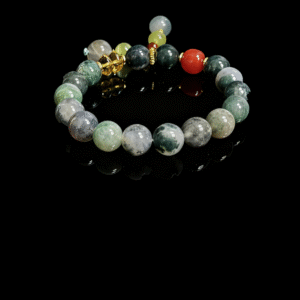
Prefer photographs of the bracelet you will receive, shown from several angles in neutral light. Close views should reveal polish, inclusions, and individual beads. When browsing Yun Agate’s Moss Agate jewelry, use the images to judge the actual pattern rather than expecting every stone to match a stock example.
Variation may appear in clarity, body color, and inclusion density from bead to bead. Decide whether you prefer a balanced strand or stronger contrast. Visible cracks, severe chips, and rough drill openings are quality concerns, not desirable patterning.
A listing should identify the material and disclose known treatments without presenting a trade name as a guarantee. Photos cannot confirm untreated status. If the description is unclear, ask the seller. Yun Agate’s guide to moss agate meaning and properties provides more background on Moss Agate’s appearance and jewelry use.
Well-finished beads should feel smooth, with clean drill openings and no cord against sharp edges. Check the cord or clasp, how the strand is secured, and whether components sit evenly. Craftsmanship matters as much as the gemstone label.
Review the stated length or wrist range rather than a generic size label. Confirm whether resizing changes the bead arrangement. Read return terms before ordering because natural variation means pieces will not look identical. Compare sizing and construction across Yun Agate’s handmade agate bracelets.
Choose Moss Agate if you prefer internal visual depth, translucent or cloudy backgrounds, and inclusions that change as light moves through the stone. Choose Tree Agate if you prefer stronger white-and-green contrast, graphic branching patterns, and a commonly more opaque appearance.
Neither is inherently better. The best choice depends on the actual piece, clear disclosure, workmanship, fit, and your visual preference. Because trade labels overlap, judge the photographs and description rather than assuming the name guarantees one exact appearance.
They are closely related chalcedony materials sold under overlapping trade names. Moss Agate often appears more translucent and layered, while Tree Agate commonly has a paler, more opaque body with green branching patterns.
No. Tree Agate is commonly opaque or nearly opaque, but individual stones may transmit some light. Cut, thickness, and lighting also affect appearance.
No. Its moss-like forms are mineral inclusions within chalcedony, not plant material.
Compare several clues: body color, translucency, pattern contrast, and visual depth. Moss Agate often looks more layered or translucent; Tree Agate commonly looks whiter and more graphic. These are tendencies, not conclusive tests.
Both have similar practical durability. Choose according to the actual bead pattern, construction, fit, disclosure, and whether you prefer atmospheric depth or stronger white-and-green contrast.