Who Is Shennong?
Shennong is written as 神农 in simplified Chinese and 神農 in traditional Chinese. The pinyin spelling is Shénnóng, while Shen Nong appears as a separated English form. “Divine Farmer” or “Divine Husbandman” is the clearest English rendering. The pinyin spelling is Shénnóng, while Shen Nong appears as a separated English form. “Divine Farmer” or “Divine Husbandman” is the clearest English rendering.
Depending on the source, Shennong may be described as a legendary ruler, culture hero, divine figure or later deity. Calling him only a “god of medicine” is too narrow: his traditions also concern farming, plant knowledge and social organization.
Was Shennong One of the Three Sovereigns?
Shennong is often counted among the Three Sovereigns, legendary culture heroes associated with early civilization. Traditional lists vary: some group him with Fuxi and Huangdi, while others include figures such as Nüwa. No single list was universally accepted.
Is Shennong the Same as Yandi?
Later traditions often identify Shennong with Yandi, the Flame Emperor or Yan Emperor. Names such as “Yandi Shennong” reflect this influential synthesis, but the figures are not treated identically in every textual layer. The most accurate short answer is that they became closely linked and were often treated as one figure in later tradition, not that every source began with the same identity.
Shennong and the Origins of Agriculture
Agriculture is central to Shennong mythology. The Appended Statements associated with the Book of Changes credit him with shaping wooden farming tools and teaching people to cultivate the land. The same textual tradition connects his age with a noonday market where people exchanged goods.
The Huainanzi adds another dimension: Shennong taught the sowing of the five grains and examined which soils, waters and conditions were suitable for different plants. These accounts portray farming as organized knowledge rather than a single miraculous invention.
Later writers credited Shennong with additional discoveries. These belong to traditions gathered around the Divine Farmer, not a verified inventory of one historical person’s inventions.
Why Did Shennong Taste the Hundred Herbs?
In the Huainanzi, Shennong tastes the flavors of the “hundred plants” or “hundred herbs” and examines water sources so that people can know what to approach and what to avoid. The story presents him as testing the natural world on humanity’s behalf.
“Hundred” need not mean a documented count of exactly 100 species; it can express a broad or numerous category. Later retellings expand the episode with poisoning stories and unusual physical features, but those additions do not all belong to the same early account.
What Does “Seventy Poisons in One Day” Mean?
The Huainanzi says Shennong encountered seventy poisons in a single day. The line emphasizes the danger of his testing and the scale of the task. It does not say that he was poisoned seventy times every day for an extended period.
Folklore sometimes adds that tea neutralized every poison. That detail is not part of this Huainanzi passage.
Did Shennong Discover Tea?
According to later legend, yes; as verifiable history, the claim cannot be established. The famous date of 2737 BCE and the story of tea leaves accidentally falling into Shennong’s boiling water belong to legendary chronology and later storytelling.
Lu Yu’s eighth-century Classic of Tea associates tea with Shennong, showing the connection’s cultural importance. It does not prove that a historical Shennong discovered tea on a particular day. Stories in which tea rescues him from poison are also later folklore.
Did Shennong Write the Shennong Bencao Jing?
No personal authorship can be demonstrated. The Shennong Bencao Jing, also written Shennong Ben Cao Jing and translated as the Divine Farmer’s Classic of Materia Medica, is traditionally attributed to Shennong’s authority.
Scholars commonly place the work’s compilation in the Eastern Han period, many centuries after the era assigned to Shennong in legend. Its transmission also reflects later preservation and revision. His name signals authority within materia-medica tradition, not proven personal authorship.
This is a question of textual history, not medical advice; traditional status does not verify a remedy’s safety or effectiveness.
Where Do the Shennong Traditions Come From?
No single early text supplies a complete “original life of Shennong.” The Book of Changes tradition emphasizes farming tools, cultivation and exchange. The Huainanzi, compiled in the second century BCE, preserves important accounts of the five grains, environmental knowledge and tasting plants.
Later religious, regional and popular traditions developed his connections with Yandi, tea, medicine and poison folklore. This layered transmission explains why modern summaries often combine details from different sources. Readers can explore more Chinese mythology stories behind Yun Agate while keeping those differences in view.
What Does Shennong Symbolize?
Shennong’s early actions made him an enduring symbol of agriculture, cultivation and plant knowledge. Modern interpretations also connect him with experimentation, discovery and the risks involved in turning observation into shared knowledge.
These are interpretations, not one moral stated by every ancient source. His legacy can represent civilization built through farming and accumulated experience, while the poison traditions suggest that discovery may carry consequences.
Shennong in Yun Agate’s Contemporary Design Story
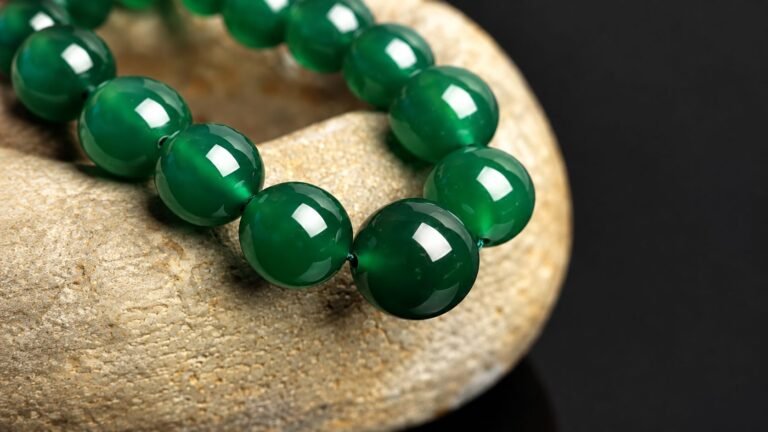
Yun Agate uses Shennong as contemporary inspiration for designs shaped by plants, land and cultivation. Green tones and moss-like natural patterns can visually recall fields, leaves and the close observation of nature associated with the Divine Farmer. The Shennong-inspired jewelry collection includes multiple stones and materials rather than one historically prescribed gemstone. Some designs use Moss Agate, whose branching inclusions support this modern visual language; readers can learn about the material separately in Yun Agate’s Moss Agate guide. This is Yun Agate’s creative interpretation, not evidence of an ancient Shennong-gemstone association. The jewelry is designed and handcrafted in Fuxin, China.
Frequently Asked Questions
Who is Shennong in Chinese mythology?
Shennong is the Divine Farmer, a legendary ruler and culture hero associated with agriculture, plant knowledge and settled civilization.
What is Shennong the god of?
He is often treated as a deity of agriculture and herbal knowledge, but traditions also present him as a ruler and culture hero.
Is Shennong the same as Yandi?
Later traditions often identify Shennong with Yandi, the Flame Emperor. Earlier textual layers do not always treat the two names and figures in exactly the same way.
Why did Shennong taste the hundred herbs?
The Huainanzi says he tested plants and water sources so people could distinguish what to approach from what to avoid. “Hundred” can indicate a broad range rather than an exact verified count.
What does “seventy poisons in one day” mean?
It is a Huainanzi phrase emphasizing the danger Shennong encountered in one day of testing. It does not mean he was poisoned seventy times every day.
Did Shennong discover tea?
Tea tradition credits him with the discovery, but the 2737 BCE date and accidental falling-leaf story are legends, not verifiable historical events.
Did Shennong write the Shennong Bencao Jing?
The text is traditionally attributed to Shennong, but its compilation occurred much later. There is no reliable evidence that the legendary Shennong personally wrote the surviving work.