Address
Designed & handcrafted in Fuxin, China
Natural agate jewelry made by hand. Worldwide shipping available.
Work Hours
Monday to Friday: 7AM - 7PM
Weekend: 10AM - 5PM
SEP 14,2026
Chang’e is one of the best-known lunar figures in Chinese mythology and is commonly described as the Chinese moon goddess. She is best known for taking an immortality elixir and going to the moon. Her story is often told alongside that of the archer Hou Yi, but there is no single definitive version explaining why she took the medicine or what happened afterward.
Early accounts are brief. Later storytellers added romance, sacrifice, punishment, the Jade Rabbit and the Moon Palace. These layers explain why Chang’e appears as a thief, protector or lonely lunar immortal in different versions.

Chang’e—sometimes written Chang E—is one of the most recognizable lunar figures in Chinese mythology. She is commonly described today as a goddess of the moon, although the stories focus less on her controlling the moon than on her journey there and continued association with it.
Earlier texts call her Heng’e, while Chang’e became the standard later form. Scholars commonly connect the change with avoidance of the personal name Heng, used by Emperor Wen of Han, although the history of the name is not preserved as one simple renaming event.
The brief early account later expanded into traditions about marriage, separation and lunar life.
Early Chang’e or Heng’e material survives through transmitted texts. The clearest secure elixir account appears in the second-century BCE Huainanzi.
The brief Huainanzi passage says that Yi obtained the medicine of immortality from Xiwangmu, the Queen Mother of the West. Heng’e then took—or, in many translations, stole—the medicine and fled to the moon.
The passage tells readers what happened, but it does not explain why Chang’e chose to take the medicine. It contains no intruder, detailed dialogue or explicit romantic motive.
Later commentary more explicitly identifies Chang’e as Yi’s wife, while subsequent storytelling develops them into a separated couple. These versions add love, regret and differing explanations for her departure.
One popular later retelling says an intruder, commonly named Peng Meng, tried to seize the elixir while Hou Yi was away. Chang’e consumed it to keep it from him and then rose to the moon. This familiar version is a later development, not part of the short Huainanzi passage.
Other versions describe theft, a deliberate search for immortality, pressured consumption or sacrifice. They are distinct retellings, not pieces of one original narrative.
In the familiar later tradition, Hou Yi is Chang’e’s husband. He is usually described as the famous archer who received the immortality medicine but did not immediately consume it.
Their separation became a defining emotional element: Hou Yi remains on earth while Chang’e lives on the moon, making immortality more complicated than a reward.
Hou Yi’s defeat of the excess suns belongs to his own mythology and need not appear in every Chang’e account. The elixir passage begins with Yi obtaining the medicine.
In the early Huainanzi account, Chang’e’s journey to the moon follows her taking the immortality medicine. The text does not explain why she selected the moon or describe her feelings as she departed.
Later versions supply different motives. Some say she escaped after stealing the elixir. Others say she swallowed it to prevent another person from taking it, acted under pressure or accepted separation to protect the medicine. Some moralized accounts interpret her lunar existence as a consequence or punishment.
For that reason, the question “Why did Chang’e drink the elixir?” has no universal answer. Her motive depends on which textual or popular version is being told.
Another early tradition differs sharply from the graceful immortal familiar in modern art.
The Eastern Han text Lingxian, associated with Zhang Heng, describes Heng’e reaching the moon and becoming a toad. This version demonstrates that Chang’e was not always imagined exclusively as a beautiful woman living in a palace.
The transformation is sometimes interpreted as punishment for taking the elixir, but that moral conclusion should not be applied to every account. Later literature and art increasingly favored the image of an elegant lunar immortal while the toad became one of several older moon symbols.
The Jade Rabbit, or Moon Rabbit, did not begin as a companion in the earliest Chang’e elixir passage. Rabbit-on-the-moon traditions had their own development before later art and literature brought the figures together.
In developed lunar imagery, the Jade Rabbit is commonly shown using a mortar and pestle to prepare immortality medicine. Chang’e and the rabbit may appear together in Guanghan Palace, often translated as the Palace of Boundless Cold.
That palace is also a later literary and visual feature rather than part of the brief Huainanzi account. A painting held by the Smithsonian National Museum of Asian Art shows this mature tradition: Chang’e occupies the lunar palace while a white rabbit prepares the elixir beside her.
Chang’e became one of the best-known figures associated with the Mid-Autumn Festival. Her lunar story is especially relevant when people gather beneath the full moon and reflect on absent family members.
However, the festival was not created solely because of Chang’e. It also draws on broader lunar, harvest, seasonal and family-reunion traditions. Her prominence developed within that larger cultural setting.
The British Museum’s Chang’e reference likewise identifies the moon goddess as particularly associated with the Mid-Autumn Festival without reducing the entire observance to her story.
The early sources state no authoritative Chang’e meaning or moral. Her symbolism developed through later interpretation and changing cultural memory.
Modern interpretations often connect Chang’e with immortality gained alongside separation and uncertainty. Her story may evoke longing, loneliness, distance, choice and responsibility. Later romantic versions emphasize the absence separating Chang’e and Hou Yi, while festival traditions can place that absence beside hopes for reunion.
Other readings focus on the uncertain consequences of seeking immortality. Chang’e escapes ordinary human limits, yet she also becomes separated from earthly life. The moon therefore represents both transcendence and remoteness—not simply a reward or a punishment.
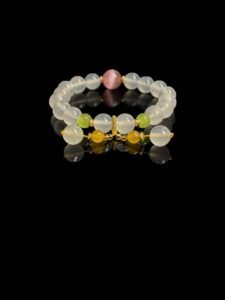
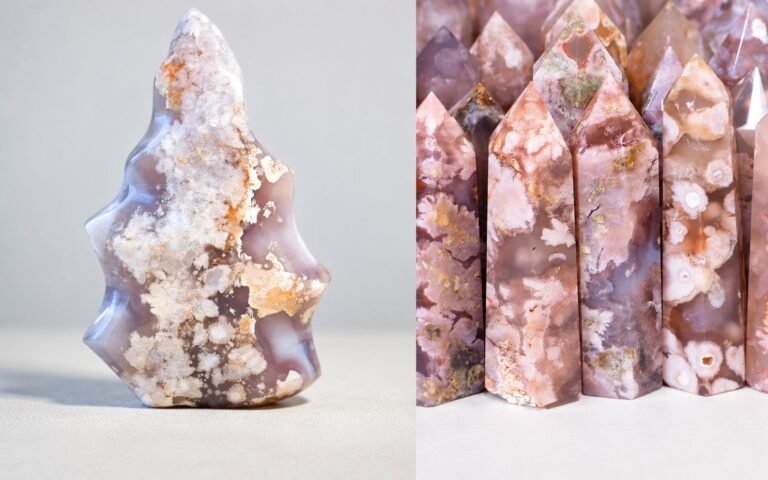
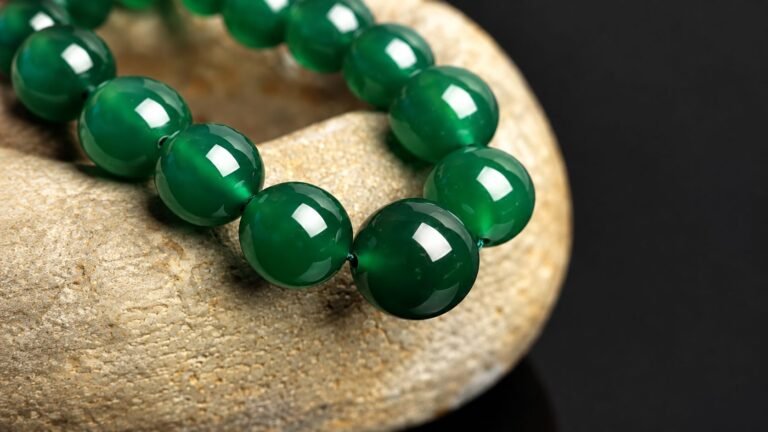
Yun Agate interprets Chang’e through contemporary jewelry rather than claiming an ancient gemstone association. Pale White Agate, translucent surfaces and softly contrasting Pink Agate can visually recall moonlight, stillness and the distance central to later versions of her story.
These materials do not have a documented historical connection with Chang’e, and they are not presented as carrying the goddess’s powers. They form Yun Agate’s modern design language for translating lunar imagery into wearable pieces. The Chang’e-inspired jewelry is designed and handcrafted in Fuxin, China as part of Yun Agate’s wider collection of Chinese mythology stories expressed through natural materials.
Chang’e is a lunar figure commonly described as the Chinese moon goddess. She is best known for taking immortality medicine and traveling to the moon.
Chang’e is commonly called the goddess of the moon. Her mythology is also associated with immortality, separation and the Mid-Autumn Festival.
Later commentary and popular tradition describe Hou Yi as Chang’e’s husband. Their separation became central to later romantic versions of the story.
The early Huainanzi passage does not give her motive. Later stories variously describe theft, self-preservation, protection of the medicine, pressure or sacrifice.
The early account says she went to the moon after taking the immortality medicine but does not explain why she chose it. Later retellings provide different explanations.
One early tradition in the Lingxian describes Heng’e becoming a toad on the moon. This is not present in every version of the Chang’e myth.
The Jade Rabbit is a lunar figure commonly shown preparing immortality medicine. Later traditions place the rabbit with Chang’e, although it is absent from the earliest brief elixir account.