Address
Designed & handcrafted in Fuxin, China
Natural agate jewelry made by hand. Worldwide shipping available.
Work Hours
Monday to Friday: 7AM - 7PM
Weekend: 10AM - 5PM
OCT 28,2026
Agate vs jasper is a common question because both stones show striking patterns and are used in jewelry, beads, carvings, and lapidary work. The most useful difference is usually not color, but internal structure and how the material transmits light. No single visual clue proves a stone’s identity. [1][4]
In common English-language gemological usage, agate is a variety of chalcedony known for characteristic growth structure and often-visible banding. Jasper is a broader, less consistently applied term for material often described as opaque and inclusion-rich, although slight translucency can occur. Trade labels vary, and mixed specimens may contain both agate-like and jasper-like zones. [1][3][5]
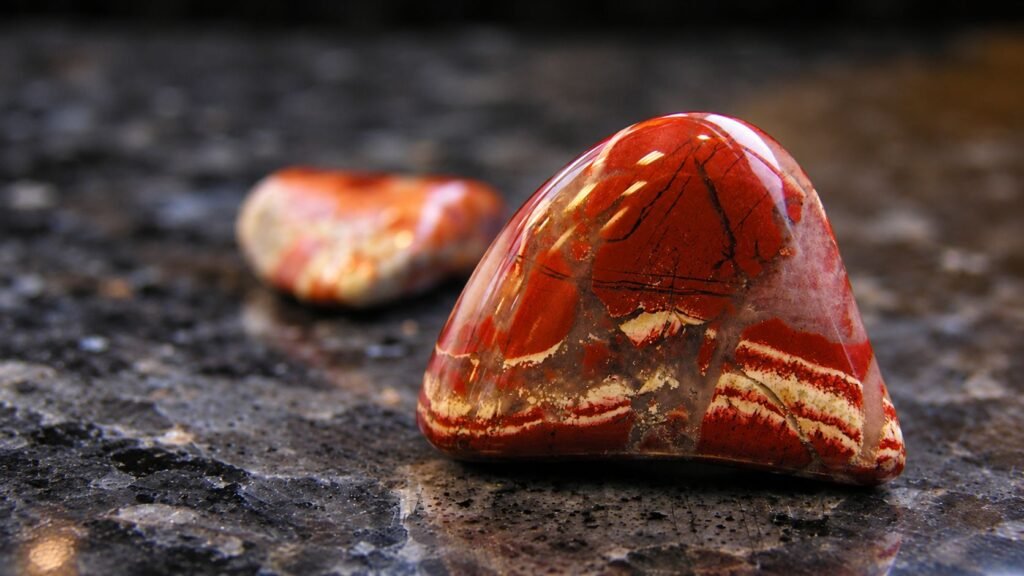
Agate often shows curved, concentric, or other structured growth boundaries. A thin edge may transmit light and reveal internal layers. Jasper is usually more opaque because inclusions and other minerals scatter or block light; its patterns may appear as patches, spots, veins, or broad bands. These are tendencies, not rules. Thick agate may look opaque, some jasper-like materials transmit a little light, and commercial names are not mineralogical diagnoses. Compare several features before choosing a label.
Feature | Agate | Jasper |
Common relationship | A variety of chalcedony with characteristic growth structure. | Commonly described as impure chalcedony or microcrystalline chert; trade usage varies. |
Light transmission | Often translucent, especially at a thin edge; thick pieces may look opaque. | Usually opaque or nearly opaque; slight translucency can occur. |
Typical pattern clues | Growth bands or boundaries, often curved or concentric; color banding may be subtle. | Patches, spots, mottling, veins, or broad bands; large-scale agate-like structure is less typical. |
Inclusions and texture | May contain inclusions; assess how they relate to growth zones. | Often inclusion-rich; inclusions may reduce translucency and add color. |
What a flashlight shows | May reveal edge translucency or internal growth boundaries. | Often shows little transmitted light, but this is not conclusive. |
Best identification approach | Combine structure, edge observation, and several viewing angles. | Combine opacity, inclusions, pattern, and reliable material information. |
Formation setting | Often grows inward from cavities or openings in silica-rich host rocks. | Jasper-related materials occur in a wider range of rock settings; the term covers varied origins. |
Hardness as a clue | Hardness is not a dependable home test for identifying agate; avoid scratch tests on finished jewelry. | Properties can overlap, and a trade name alone does not establish composition. |
Naming caution | Not every striped stone is agate. | Not every material sold as jasper fits a strict gemological definition. |
Both materials are associated with silica-rich rocks and are commonly discussed within the chalcedony family. Chalcedony is made of very small interlocking quartz crystals that are not normally visible as individual crystals to the unaided eye. Authors differ in how they use “microcrystalline” and “cryptocrystalline,” which is one reason gemstone terminology can feel inconsistent. [1][4]
Both can take a good polish and show many colors. Iron oxides and other inclusions may contribute to reds, browns, yellows, greens, and darker areas, but color or finish alone does not establish composition.
Agate is usually used for chalcedony with characteristic growth structure, including boundaries between growth zones that may or may not form obvious color bands. Jasper is a broader and less consistently applied term. It often refers to opaque, impure chalcedony or microcrystalline chert, but sellers also use “jasper” for some decorative rocks that do not fit a strict gemological definition. GIA’s study of material sold as “Dalmatian jasper,” for example, found that the examined samples were a different type of rock and recommended “Dalmatian stone.” [3][5]
A trade name is useful context, not proof of composition. Describe visible features and disclose what is known rather than identifying a stone by color alone.
One of the first things people notice is how much light passes through a stone. Many agates are translucent, especially at a thin edge. When light is placed behind that edge, internal bands or curved growth boundaries may become easier to see. Jasper is usually opaque or nearly opaque, although the term covers a range of materials and the boundary is not absolute. [1][3][5]
Thickness matters: a thick agate can look opaque from the front even when a thin edge transmits light. Weathering, inclusions, dark color, coatings, and cut also affect the result. Slight translucency does not automatically identify agate, and opacity alone does not prove that a specimen is jasper.
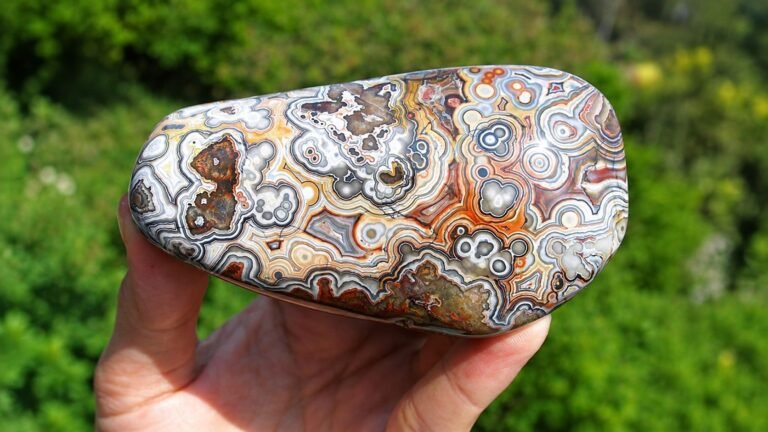
Agate is associated with a fibrous growth structure and structural banding. The bands may be curved, concentric, straight, wavy, or irregular. Some agates show dramatic color stripes; others have subtle boundaries that are easier to see when backlit. Not every stripe on a stone is an agate band, though. Sedimentary layers, mineral veins, fractures, surface staining, and patterns in other rocks can also create lines.
Jasper can show spots, mottling, patches, veins, or broad bands. Some jasper-like materials are patterned enough to resemble agate, and small agate-like areas can occur within a more opaque host material. Look at the pattern across more than one face and ask whether it follows a repeated internal growth structure. If the evidence is ambiguous, do not treat an attractive pattern as a definitive identification. [3][5]
Jasper commonly contains abundant fine inclusions, including iron oxides or hydroxides and other minerals. These can contribute color and reduce translucency. Agate can also contain inclusions and colorful internal scenes, so inclusions alone do not separate the two. Instead, observe how the inclusions relate to the surrounding structure: are they set within recognizable chalcedony growth zones, or do they form a more diffuse, patchy, or granular appearance?
A polished surface tells you more about how a stone was worked than what it is. Texture, luster, and inclusions should support, not replace, a broader assessment.
Agate commonly develops in cavities or openings, including spaces that were once gas bubbles in volcanic rocks. Chalcedony grows inward from cavity walls, and successive growth zones can create the structures associated with agate. Jasper-related materials have a wider range of reported rock settings and origins, so formation history is useful background rather than a reliable home test. [1][3][5]
Formation history provides useful background, but it usually cannot be established from a finished bead by sight alone.
If you want to know how to tell agate from jasper, start with a careful, non-destructive sequence. These observations can help you describe what you see, but they are not a substitute for professional identification when the answer matters.
A flashlight may reveal translucency or internal structure at a thin edge, but it cannot prove identity. Thickness, color, inclusions, cut, surface condition, and viewing angle all affect the result.
Some specimens contain both translucent chalcedony or agate-like zones and opaque jasper-like zones. Labels you may encounter include “jaspagate,” “jasp-agate,” and “jasper-agate.” These terms are not used consistently across every reference or seller. In this article, “jaspagate” is a convenient descriptive term for a mixed-looking specimen, not a universally standardized classification. [1][3][5]
Describe the visible mixed zones without assuming that every red-and-white, striped, or patchy stone combines agate and jasper. A trade name alone does not establish composition. If the precise identity matters for a purchase, resale, or collection record, ask for the seller’s evidence or seek a qualified assessment.
Red agate and red jasper can both show warm red, orange-red, rust, or brown tones. Color alone is not enough to tell them apart. Red agate may show translucent edges or recognizable growth banding; red jasper is more likely to be opaque and inclusion-rich. Yet thick agate can appear opaque, and a banded pattern alone is not conclusive.
If your question is specifically about red stones, keep the material-identification question separate from the distinction between red agate and carnelian. Our guide to red agate vs. carnelian covers that related comparison in more detail. A cautious description should state what the stone visibly shows and avoid claiming a precise identity unless it has been verified.
Photos can show useful features but cannot always establish identity. For an online listing or purchase, request or provide:
Highly saturated photos and dramatic lighting can distort a stone’s appearance. A trustworthy seller should distinguish visual observations from laboratory-confirmed identification and disclose any treatment known to them. Our dyed agate guide covers treatment questions separately. If your main concern is price, our agate value guide explains the factors that can affect value.
Consider professional assessment if the material is high-value, the seller’s description is disputed, mixed zones are present, treatment could affect identity or value, or you need documentation for resale or insurance. A qualified gemologist or laboratory can choose suitable non-destructive methods. Some jasper-like trade materials may require more detailed mineralogical or petrological analysis. [3][5]
For broader background, read our What Is Agate? Types, Properties & Jewelry Guide. For genuine-versus-imitation questions, see our separate guide to telling if agate is real.
Usually, no—not as a precise identification. Agate is a variety of chalcedony known for characteristic growth structure, while jasper is a broader term often used for opaque, inclusion-rich silica materials. The terms can overlap in commercial descriptions, and a mixed specimen may contain agate-like and jasper-like zones. Use the name that best fits the evidence, and note uncertainty when composition has not been independently confirmed. [1][3][5]
Jasper is commonly described as impure chalcedony or microcrystalline chert, but the term is also used broadly in the gem and rock trade. Some materials sold as jasper may not fit a strict gemological definition, so a trade name alone is not proof of composition. [3][5]
Jasper is usually opaque, but descriptions may allow slight translucency, and the boundary is not absolute. Thickness, inclusions, and the specific material affect how much light passes through.
A specimen may contain translucent agate-like or chalcedony zones alongside opaque jasper-like zones. A mixed-material description may be appropriate when the visible structure supports it, but the label should not be assigned from color alone.
Jaspagate is a descriptive term used for specimens with agate-like and jasper-like features. Related labels include jasp-agate and jasper-agate, but usage varies. Because the terms are not universally standardized, describe the visible structure and do not infer exact composition from the label alone.
No. Backlighting can reveal translucency or internal structure, especially at a thin edge, but it cannot confirm identity by itself. Thick agate may look opaque, and other materials may transmit some light.
A photo may show useful clues, but one image can hide the edge, internal structure, thickness, or true color. Multiple views and treatment disclosures help, but some specimens still require professional assessment.
When comparing agate and jasper, start with internal structure and light transmission, then check patterns and inclusions across several faces. Agate often reveals characteristic growth boundaries and may transmit light at a thin edge; jasper is usually more opaque and inclusion-rich. Neither clue is absolute, and trade names can be inconsistent. The best identification is the one that fits the evidence—and is honest about what remains uncertain.
[1] Gem-A, “Buying Guide: Get to Know the Different Types of Chalcedony” (2023). https://gem-a.com/gem-hub/different-types-of-chalcedony/
[2] Mindat, “Agate” (physical properties and variety information). https://www.mindat.org/min-51.html
[3] GIA, “True Colors of ‘Dalmatian Jasper’” (Gems & Gemology, Fall 2017). https://www.gia.edu/gems-gemology/fall-2017-dalmatian-jasper
[4] GIA, “Gem Cutters Reveal the Beauty of Chalcedony” (2016). https://www.gia.edu/gia-news-research/gem-cutters-reveal-beauty-chalcedony
[5] Mindat, “Jasper” (classification and terminology). https://www.mindat.org/min-2082.html
FEATURED PRODUCTS