Address
Designed & handcrafted in Fuxin, China
Natural agate jewelry made by hand. Worldwide shipping available.
Work Hours
Monday to Friday: 7AM - 7PM
Weekend: 10AM - 5PM
OCT 16,2026
Green agate sounds simple, but the material can vary widely. One piece may show pale green bands and soft translucency; another may be a deeper, more uniform green; a third may contain branching inclusions associated with Moss Agate. Some material is naturally green, while other green-colored agate has been dyed. For buyers, what matters is accurate identification and treatment disclosure.
This guide explains what green agate means in the jewelry market, how its appearance can vary, how Moss Agate fits into the broader topic, and what to check before buying green agate jewelry.
Agate is generally described as a variety of chalcedony, a microcrystalline form of quartz. Many agates show bands, layers, color zones, or distinctive inclusions, although not every piece displays all of those features clearly. For a broader introduction to the material, see Yun Agate’s general guide to agate.
In the consumer market, green agate is a broad color-based name rather than one perfectly uniform appearance. The label may be used for naturally colored green agate, dyed agate, or green chalcedony sold under an agate trade description. That breadth makes the seller’s material and treatment information especially important. The name alone does not tell you the exact cause of color, whether treatment was used, or where the rough was mined.
The phrase is not always used with exactly the same scope in jewelry listings and gemological references. That makes three details especially useful: the most precise material identification the seller can support, a clear statement about known or unknown treatment, and transparent answers to reasonable questions. A stone should not be assumed natural or treated solely because it looks green or is marketed as green agate.
A responsible description should identify the stone as precisely as the seller can support. If a listing uses a more specific name, such as Moss Agate, chrysoprase, or chrome chalcedony, that name should match the material rather than being chosen only because the stone is green.
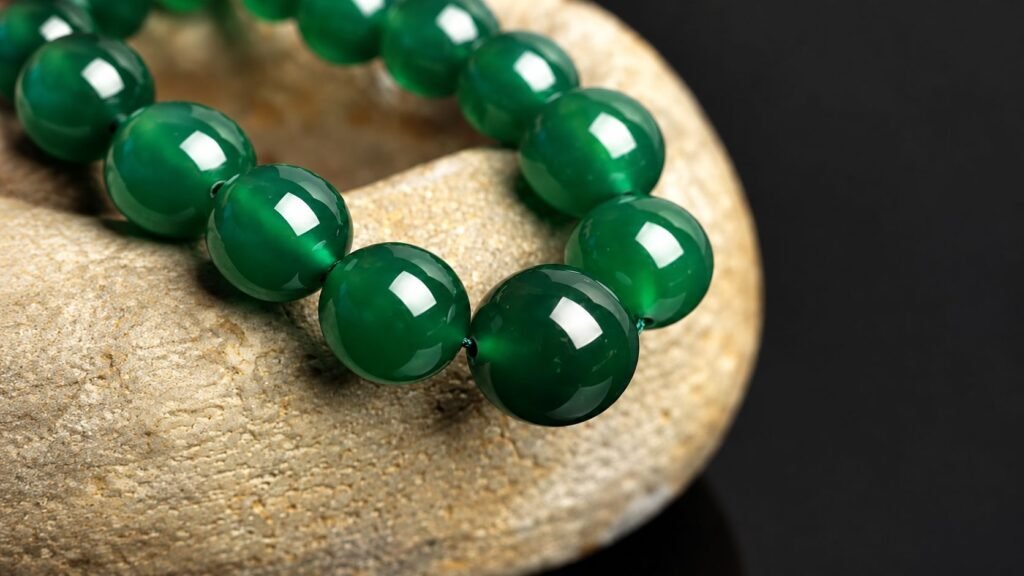
Green agate can range from soft gray-green and sage to brighter apple, blue-green, or deep forest tones. It may be translucent, cloudy, or more opaque. Some pieces show crisp or faint banding; others contain color zones, plumes, specks, or branching inclusions. Cut and polish also affect what the eye sees: a thin translucent bead may look brighter than a thick carving made from similar rough, and a glossy surface can intensify color under direct light.
Natural stone varies. Beads in one bracelet may be coordinated without being identical, while a carving can combine several tones or patterns in one object. This variation can be part of the material’s appeal, but it is not proof that the color is natural. Likewise, a saturated green does not by itself prove that a stone is dyed. Photographs provide useful clues, not a complete identification, because lighting, white balance, editing, and screen settings can all shift green tones.
Moss Agate fits naturally within a broader discussion of green agate because many examples contain green, moss-like patterns. The terms are not interchangeable, however, and not every gemological reference describes their relationship as a formal mineralogical hierarchy.
Moss Agate is an established trade and gemological term commonly used for chalcedony with moss-like, branching, or dendritic inclusions. Those inclusions, rather than green color by itself, create the characteristic appearance. A plain green banded stone is not automatically Moss Agate. Moss Agate can also combine green with white, clear, brown, reddish, or other tones, and some pieces show little or no conventional agate banding.
If you want to learn more specifically about these inclusion patterns, their symbolism, and jewelry considerations, see Yun Agate’s guide to Moss Agate.
Chalcedony and agate occur in many colors and appearances, and naturally colored green chalcedony is known. Green-colored agate is also commonly encountered in treated form. GIA notes that agate’s porosity makes it receptive to dye, which allows color to enter parts of the stone more readily than it would in many less porous gems.
This does not justify either common extreme: not all green-colored agate is dyed, and not all of it is naturally green. Strong, unusually even, or highly saturated color is a reason to ask questions, not a diagnosis. Some dyed pieces may show color concentration in fractures, around drill holes, or in more porous bands. Other treatments can be difficult or impossible to confirm from ordinary photographs. A seller’s disclosure, supporting documentation, and, when the stakes justify it, professional gemological testing are more reliable than a home color test.
CIBJO’s Gemstone Book sets out international trade nomenclature and disclosure guidance, including provisions for treated gemstones and material suspected of treatment. Those rules support accurate description; they do not establish treatment status from green color alone. Gemological literature also documents natural-color green chalcedony. The practical takeaway is to look for an exact material name and a clear treatment statement instead of treating color as proof in either direction.
Treatment disclosure matters because it helps buyers understand what they are purchasing and how to care for it. In the United States, FTC guidance emphasizes disclosure when a gemstone treatment is not permanent, creates special-care requirements, or significantly affects value. For a fuller explanation of coloring methods and stability, read Yun Agate’s guide to dyed agate.
Begin with the product description rather than the color alone. Look for clear wording such as natural color, dyed, color-treated, or treatment unknown. Then compare that wording with the photographs. Color that gathers along cracks, drill holes, edges, or porous bands can be a clue to dyeing. Extremely uniform color across stones that otherwise have different textures may also justify a question.
None of these observations proves treatment. Natural color zoning can look uneven, and skilled dyeing may appear uniform. Avoid scratch tests, solvents, bleach, heat, or other destructive experiments on finished jewelry. If identity or treatment materially affects a purchase, ask the seller for evidence or consult a qualified gemologist. Yun Agate’s guide on how to tell if agate is real explains the limits of visual checks and home testing in more detail.
Several green chalcedony materials can look similar in a product photograph, but their names should not be treated as interchangeable. The comparison below is a buying aid, not a substitute for gemological testing.
Market term | Typical description | Buyer takeaway |
Green agate | Broad green agate or chalcedony market category; may be natural-color or treated | Ask what the material is and whether color treatment is disclosed |
Moss Agate | Chalcedony with characteristic moss-like or dendritic inclusions | Green color alone is not enough; look for the defining inclusion patterns |
Chrysoprase | Translucent green chalcedony commonly associated with nickel-related color | A distinct named material, not a subtype of Green Agate |
Chrome chalcedony | Green chalcedony colored by chromium | Another distinct green chalcedony material, not a Green Agate subtype |
Color and transparency can overlap across these names. A bright apple-green stone is not automatically chrysoprase, and a deep green stone is not automatically chrome chalcedony. Accurate naming depends on material evidence, not a visual shortcut. When a listing is unclear, ask the seller which name is being used, why it applies, and whether the color is natural or treated.
Green agate meaning is best understood through traditional symbolism rather than laboratory science. In symbolic traditions, green is often associated with growth, renewal, balance, and a connection to the natural world. Agate has also been used for centuries as an ornamental and personal stone, so some people choose a green piece to represent steadiness, patience, or a new beginning.
These associations are interpretive, not measurable properties of the gemstone. A bracelet or pendant may serve as a personal reminder of a goal, a transition, or the kind of calm attention someone hopes to bring to daily life, but that meaning comes from the wearer and the tradition they value. It should not be presented as evidence that the stone can treat anxiety, improve circulation, relieve pain, change blood pressure, help sleep, or produce any other medical or psychological effect. Spiritual ideas, including chakra associations, may be part of an individual’s beliefs, but they are not scientific claims and should be described as such.
Green agate works well in bracelets, necklaces, pendants, earrings, cabochons, beads, and small carved pieces because its color, patterns, and translucency can remain visible after polishing. Softer sage or gray-green tones can feel understated, while darker forest shades or saturated green beads create a stronger color statement. Simple metalwork and neutral clothing can leave more attention on banding, clouds, inclusions, or color zones within the stone.
Natural variation means two pieces cut from different parts of the same rough may not look identical. A necklace may combine carefully matched beads, while earrings may be selected for similarity without being exact mirror images. Carved pieces can reveal several tones or patterns as their surfaces turn through the light. Buyers who prefer consistency should look closely at photographs of the actual item; those who enjoy variation may value the small differences that make each piece distinctive. Treatment and photography can also affect apparent color, so appearance should always be considered together with the seller’s material description.
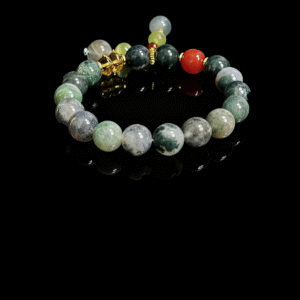
A green agate bracelet may use closely matched beads or deliberately varied stones. Check bead diameter, bracelet length, stringing method, and the seller’s fit guidance rather than relying only on a model photograph. Larger beads have more visual weight and can change how a bracelet looks and feels on the wrist. If the material has not been confirmed as green agate, a retailer should not apply that name merely because the bracelet contains green jade, jadeite, glass, or another green gemstone.
When confirmed green agate inventory is not available, it is more accurate to browse a broader handmade bracelet collection and verify each product’s stated material individually than to assume every green design belongs in this category.
A useful listing should make the material easier to understand, not hide it behind color language. Before buying, review the following points:
Be cautious with universal price claims. Value depends on the exact material, treatment, color, pattern, size, condition, matching, workmanship, setting, documentation, and current market. A green stone is not automatically rare or investment-grade. Yun Agate is an independent jewelry brand based in Fuxin, China, working with handmade and small-workshop production for U.S. customers; that craft context does not replace clear material and treatment disclosure.
For routine care, use lukewarm water, mild soap, and a soft cloth or soft brush, then rinse and dry thoroughly. Many untreated agates tolerate normal gentle care, but the strongest precautions apply when a stone is dyed, otherwise treated, or its treatment status is unknown. Keep those pieces away from prolonged direct sunlight, harsh chemicals, alcohol or other solvents, and acetone, all of which may affect some color treatments.
Avoid unnecessary ultrasonic and steam cleaning when treatment is known or uncertain. Remove bracelets before swimming, showering, heavy exercise, or household cleaning, and store pieces separately to reduce scratching. If a seller provides treatment-specific care instructions, follow them. See the complete agate jewelry care guide for detailed instructions.
Green agate is a broad consumer and market term for green-colored agate or chalcedony material sold as agate. It can vary in shade, translucency, banding, inclusions, and treatment status, so the name should be supported by an accurate product description.
It can be either. Naturally colored green chalcedony exists, and dyed green agate is also common. Color alone cannot establish treatment. Ask for disclosure and avoid sellers who present certainty without support.
Moss Agate is often discussed within the broader subject of green agate because many pieces contain green, moss-like patterns. The terms are not interchangeable, though. Moss Agate is recognized by characteristic moss-like, branching, or dendritic inclusions, not by green color alone, and gemological references do not all frame the relationship as a formal subtype.
Possible clues include color concentrated in fractures, drill holes, or porous bands, and unusually uniform saturation. These clues are not proof. Seller disclosure or professional testing is more reliable than photographs or destructive home tests.
Green agate is a broad market category that may include banded or treated material. Chrysoprase is a distinct named variety of green chalcedony commonly associated with nickel-related color. Chrysoprase should not be described as a subtype of Green Agate.
Yes, agate is widely used in beads, cabochons, pendants, and carvings. Suitability still depends on the individual stone, treatment stability, setting, construction, and how the piece will be worn and cared for.
Green agate is best understood as a varied color and market category, not one standardized look. Buyers should expect differences in color, pattern, translucency, and inclusions, while asking direct questions about material and treatment. Moss Agate is more specifically recognized by its characteristic inclusions, while chrysoprase and chrome chalcedony should remain clearly distinguished. With those boundaries in place, the name green agate can be useful, accurate, and practical for jewelry shoppers.
GIA – Gem Cutters Reveal the Beauty of Chalcedony
GIA – An Introduction to Gem Treatments
GIA – A New Natural-Color Bluish Green Chalcedony
Gem-A – Get to Know the Different Types of Chalcedony
FTC – In the Loupe: Advertising Diamonds, Gemstones and Pearls
FEATURED PRODUCTS