Where Does the Xingtian Story Come From?
The Account in the Shan Hai Jing
The surviving early account appears in Guideways Beyond the Seas: West, a section of the Shan Hai Jing. The title is commonly translated as the Classic of Mountains and Seas or Guideways Through Mountains and Seas.
The work is a composite text assembled over time, so the myth cannot be assigned one precise composition date. Its Xingtian passage briefly reports the conflict, beheading, altered body, weapons, and continued movement without supplying a biography or moral. Readers can consult the Chinese passage in the Chinese Text Project’s Western Classic of the Overseas Regions, while Richard E. Strassberg’s A Chinese Bestiary provides a scholarly English translation and study.
Di, the Yellow Emperor, and Later Retellings
In the early passage, Xingtian’s opponent is called Di, a term translated in different contexts as Supreme Deity, Thearch, or Emperor. Later traditions and modern retellings commonly identify this figure with Huangdi, the Yellow Emperor.
These versions are related but not automatically identical. The early passage gives Xingtian no detailed motive or dialogue; political alliances, speeches, and elaborate reasons for the battle belong to later storytelling.
The Story of Xingtian
Xingtian’s Battle and Beheading
The Shan Hai Jing says that Xingtian contended with Di over divine power or supremacy. Di cut off Xingtian’s head and buried it at Changyang Mountain.
The text does not say that Xingtian grew another head, became immortal, or returned fully to life. Instead, his headless body continued to move, creating the unforgettable form for which the Xingtian myth is known.
The Headless Warrior Who Kept Moving
After the beheading, Xingtian uses his breasts or nipples as eyes and his navel as a mouth. He then holds his weapons and continues a martial dance or display.
Modern summaries often say that he “kept fighting forever,” but the early passage is more restrained. It shows him continuing martial movement after losing his head; it does not explicitly describe an endless second battle.
Why Does Xingtian Have Eyes on His Chest?
Xingtian’s chest eyes and navel mouth replace the face lost with his severed head. “Eyes on his chest” is a useful modern shorthand, although “breasts or nipples as eyes” is closer to the textual image.
The myth offers no anatomical explanation. Its force comes from the image itself: even deprived of the body part associated with sight and speech, Xingtian still acts. Later readers have understood this altered body as an image of resistance.
What Weapons Does Xingtian Carry?
The source names two weapons using the terms gan and qi. These are usually rendered as a shield and battle-axe, although translations vary slightly.
Unlike the axe frequently added to modern images of Pangu, Xingtian’s axe-like weapon has early textual support. His weapons reinforce his identity as a martial figure.
What Does Xingtian Symbolize?
Defiance and Refusal to Yield
Modern interpretations connect Xingtian symbolism with defiance after defeat, courage, determination, and resistance against overwhelming power. Despite an apparently final loss, he refuses to become passive.
Xingtian is therefore often described as an image of indomitable will. That is a later cultural interpretation, not a moral announced in the Shan Hai Jing passage.
Persistence, Conflict, and an Uncertain Struggle
The image also allows a more complicated reading. Xingtian continues, but the source does not promise victory or resolution. His movement may represent unresolved conflict, resistance without guaranteed success, or even struggle that cannot change its outcome.
This ambiguity distinguishes him from a simple motivational hero. His meaning lies not in guaranteed triumph, but in remaining defiant after defeat.
Xingtian in Yun Agate’s Contemporary Design Story
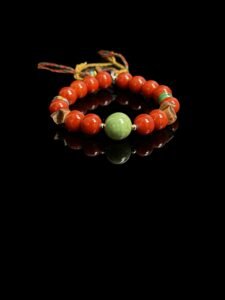
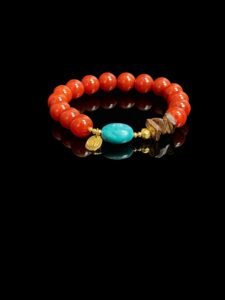
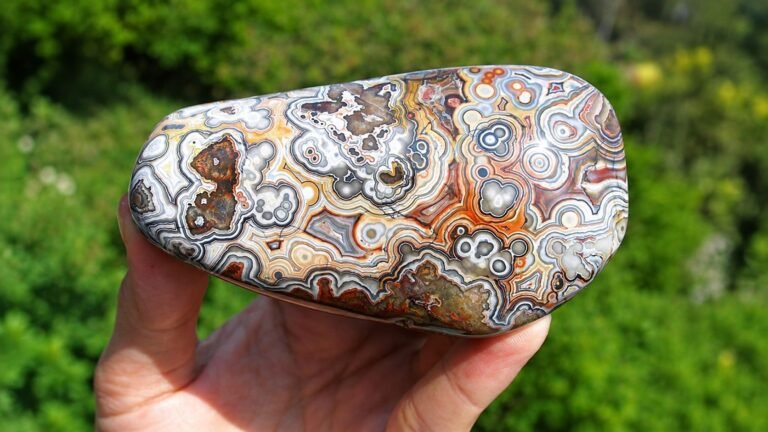
Yun Agate interprets Xingtian through contemporary jewelry rather than claiming an ancient gemstone association. In the brand’s design language, red tones and dark contrasts can evoke conflict, movement, and defiance after defeat. This is a modern creative response to the myth; it does not mean historical Chinese tradition assigned Red Agate to Xingtian or believed the stone carried his powers.
Yun Agate designs, handcrafts, and assembles jewelry in Fuxin, China. The Xingtian-inspired jewelry collection translates the figure’s visual character into wearable designs and forms part of the wider Chinese mythology stories behind Yun Agate.
Frequently Asked Questions
Who is Xingtian in Chinese mythology?
Xingtian is a mythic warrior or deity described in the Shan Hai Jing. He is famous for continuing a martial display after being decapitated.
Why is Xingtian headless?
Xingtian is headless because Di defeated and decapitated him during a contest over divine power. His severed head was then buried at Changyang Mountain.
Who cut off Xingtian’s head?
The early passage names his opponent as Di. Later retellings commonly identify Di with Huangdi, the Yellow Emperor, but the two descriptions should not be substituted without explanation.
Why are Xingtian’s eyes on his chest and his mouth in his navel?
The text says he uses his breasts or nipples as eyes and his navel as a mouth after losing his head. It does not explain physically how this transformation happens.
What weapons does Xingtian carry?
Xingtian carries gan and qi, commonly translated as a shield and battle-axe. Translation choices can vary slightly.
What does Xingtian symbolize?
Later literature and modern culture commonly interpret Xingtian as a symbol of defiance, determination, resistance, and refusal to yield after defeat. The early source itself does not prescribe one authoritative moral.